
Roof repair in El Paso, TX, day or night
Roof repair covers the problems that are still local: missing or lifted shingles, failed flashing (the metal strips that seal the joints around chimneys, vents and walls), cracked pipe boots, and damage from a single storm. Roofing Pros EPTX repairs roofs across El Paso and the nearby towns. If a repair will genuinely hold, we repair it, because a repair done at the right time is what keeps a roof from becoming a replacement.
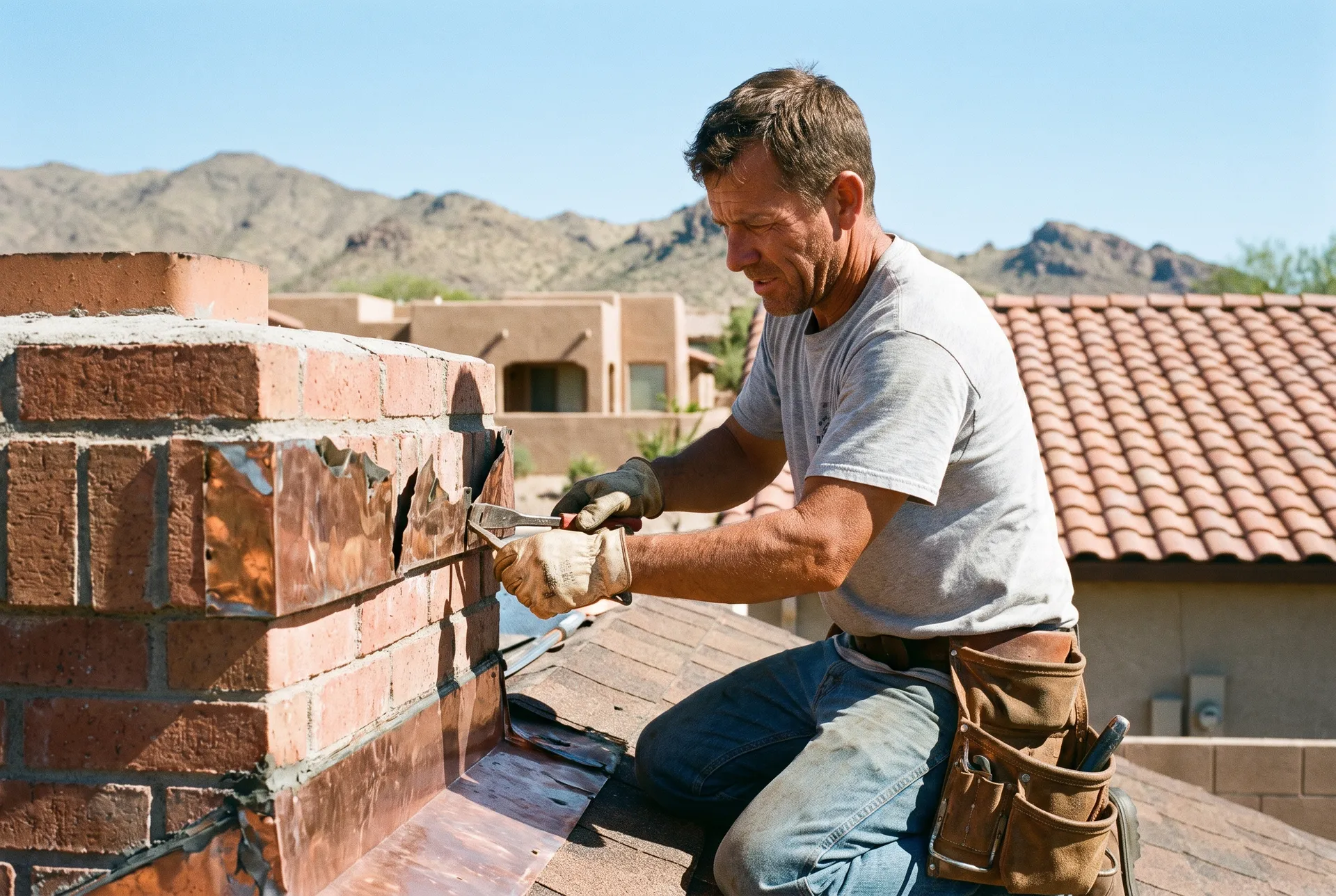
The roof repairs we do most often in El Paso
Roofs here fail in a fairly predictable set of places. Almost none of them are out in the open field of the roof, which is the part designed to shed water and generally does its job. The failures cluster at joints, at penetrations, and at anything made of a different material than the roof around it.
- Flashing. Flashing is the metal that seals a joint where the roof meets something else: a chimney, a wall, a vent, a valley. It is the single most common source of the leaks we trace, because joints are where movement and water both concentrate.
- Wind-lifted and missing shingles. Monsoon downbursts crease shingles as often as they remove them. A creased shingle has broken its seal and will not lie flat again, so the next storm gets underneath it.
- Cracked pipe boots. The rubber collar around a plumbing vent is usually the first thing on an El Paso roof to fail, because it is a small piece of rubber sitting in relentless UV.
- Worn spots and bald patches. Where granules have scrubbed away, often below a valley or under a downspout, the mat underneath is exposed and aging several times faster than the rest.
- Swamp cooler and equipment curbs. Evaporative coolers are common on roofs here. The curb, the pan and the seal around them are a standing leak risk and they are frequently ignored.
- Flat and low-slope seams. On a membrane roof the seam is the weak point, and ponding water sitting on a seam finds its way through eventually.
If water has already reached a ceiling, that is a different job, and it starts with tracing where the water is really entering. See roof leak repair.
Repair or replace: how we decide
The honest test is not how bad the damage looks. It is whether the rest of the roof has enough life left to be worth protecting. A well-placed repair on a roof with years remaining is one of the best-value jobs in the trade. The same repair on a roof that is finished is money you will spend again shortly.
We look at three things. First, how much of the roof is affected: one area or every slope. Second, the condition of the surrounding material, meaning whether the shingles next to the damage are still flexible or already brittle and shedding granules. Third, the decking, because soft decking is a structural problem that a surface repair does not touch.
There is also a code angle worth knowing. Repairs past roughly a quarter of a roof section within a twelve month period generally trigger a requirement to bring the whole section up to current code, which changes the math considerably. That is a jurisdiction question, so it gets confirmed with the City of El Paso rather than assumed. When a repair is close to that line, a roof replacement is often the cheaper answer over any horizon longer than one summer.
Why small roof problems get expensive in this climate
Water that gets past the surface does not announce itself. It runs along the decking, soaks into insulation, and eventually shows on a ceiling in a room that is nowhere near the actual hole. By the time there is a stain on the drywall, the decking above it has usually been wet through several storms.
El Paso makes this worse in a specific way. NOAA defines the North American monsoon as reaching this region roughly mid-June through September, and the rain arrives in concentrated bursts during that stretch rather than spread across the year, so a roof can hold a defect for months with nothing to show for it, then take four hard storms in six weeks. Between those storms the sun bakes the wet material, which is how a small opening becomes a large one without anybody touching it.
That is the argument for fixing the small thing in spring rather than the large thing in August. Monsoon season does not test your roof gently and it does not test it once.
Warning signs you can check from the ground
You do not need to get on the roof, and we would rather you did not. Most of the early warnings are visible from the yard, from a window, or from inside the house.
- Granules in the gutters or at the downspout outlet. A handful after a new roof is normal. An ongoing pile is the roof surface wearing away.
- Shingles that look uneven along a ridge or edge. Lifted or displaced pieces read as a wavy line where there should be a straight one.
- Dark patches on a slope. Seen from across the street, these often mark bruising or missing granules.
- Stains on a ceiling or the top of an interior wall. Even a faint yellow ring means water has been present.
- Daylight or damp insulation in the attic. The cheapest inspection anyone can run, and it takes two minutes with a flashlight.
- Debris in the yard that used to be on the roof. Pieces of shingle, ridge cap or flashing on the ground after a storm are worth a call the same week.
Any one of these is worth a free look. None of them get better on their own, and all of them are cheaper this month than next season.
How a repair visit actually runs
There is no mystery to it, and there should not be. Here is the order of events from your first call to the crew leaving.
- You call or send the form. Tell us what you are seeing and roughly when it started. If water is actively coming into the house, say so, because that changes how we schedule it.
- We come out and get on the roof. Not a look from the driveway. We check the area you noticed and the places that commonly cause it, which are often not the same place.
- You get photographs. We show you what we found rather than describing it. You should be able to see the problem yourself.
- Written estimate. Itemized, in writing, free, and yours to keep whether or not you hire us.
- The repair. Most repairs are a single visit. Materials matched as closely as the existing roof allows, and any wet or rotted decking under the repair replaced rather than covered.
- Cleanup. Debris removed and a magnet run for nails before the truck leaves.
Repairs on tile, metal and flat roofs
Not every El Paso roof is asphalt shingle, and the others fail in their own ways. A crew that only knows shingles will treat a tile roof like a shingle roof, which is how tile gets walked on and broken during a repair.
On concrete and clay tile, the tile is a rain screen and the actual waterproofing is the underlayment beneath it. That means a tile roof can leak with every tile perfectly intact, and it means a repair often involves lifting tile, renewing underlayment, and setting the tile back. It also means you should not have people walking it casually. See tile roof repair for how we handle cracked, slipped and broken tile and what walking a tile roof safely actually involves.
On metal roofs the failures are usually at fasteners, seams and penetrations rather than in the panel, because metal expands and contracts hard through an El Paso day. On flat and low-slope roofs with TPO or modified bitumen, the failures are seams, flashing at parapet walls, and drainage. Ponding water is the enemy on those, and often the real fix is drainage rather than patching. See flat roof repair for more on those systems. We work on all of these.
Roof leaking right now?
Water actively coming into the house during a storm is a different situation than a repair you can schedule for next week, and it deserves its own page rather than a few lines here. See emergency roof repair for what to do in the first hour and what to expect when we get there. Roofing Pros EPTX answers around the clock, which matters most at the exact hours nobody wants to be on a roof.
What a repair costs, and why we will not guess
The price of a repair depends on the size of the affected area, what material has to be matched, whether the decking underneath is sound, how steep and how accessible the roof is, and how many separate spots need attention. Those are real variables, and a number given before somebody has looked is not an estimate; it is a hook.
What we can promise is the structure of the answer. You get a written, itemized figure before any work starts, with the decking contingency stated rather than left open, and a straight explanation of whether this is a real fix or a patch buying you a season. Those are different products and you deserve to know which one you are paying for.
You will also get told when the repair is not worth doing. That happens, and saying it out loud costs us the job in the short run. It is still the right answer, and it is why we would rather build the business on honest inspections than on one-time sales.
Storm damage repairs and your insurance
If the damage came from a hail or wind event, the repair conversation may also be an insurance conversation. Those overlap but they are not the same, and it is worth keeping them separate in your head.
Our part is documentation and repair. We photograph what the storm did, describe it accurately, and give you a written scope you can hand to your adjuster. We are roofers, not your insurer and not a public adjuster, so we will not tell you what your policy owes you or promise you a claim outcome. Anyone who does is telling you something they cannot know.
Timing matters here more than people expect. Damage documented close to the storm date is far easier to establish than the same damage found two years later, by which point it looks like age. If a storm has been through your area, get it recorded even if you do not intend to file. More on that on our storm and hail damage page.
Keeping a repaired roof from needing the next repair
Most of what shortens a roof in this city is maintenance that never happened. None of it is expensive, and almost all of it is seasonal rather than constant.
- Clear the drainage before June. Gutters, scuppers and flat-roof drains fill with wind-blown dust and grit here, not just leaves. Clear them before the monsoon rather than during it.
- Check after every serious storm. A five minute look from the ground catches lifted shingles and missing ridge cap while the fix is still small.
- Replace pipe boots on schedule. They are cheap, they fail in the sun, and they cause leaks out of proportion to their size.
- Service the swamp cooler properly. The seal and pan around a roof-mounted cooler need attention every year, and a poorly reseated unit leaks straight into the house.
- Keep foot traffic off. Every trip across a hot asphalt roof scuffs granules loose. Antennas, satellite installs and casual inspections all cost the roof something.
- Get an annual look. Once a year plus after any hail is a reasonable rhythm in this climate, and ours is free.
Related services
Frequently asked questions
How fast can you get out to look at a roof repair?
Same week in most cases across El Paso and the surrounding communities, and often sooner. If water is actively coming into the house, tell us that when you call and we will treat it as urgent, because active water damages decking, insulation and drywall every hour it continues. We answer around the clock, which is deliberate, since roof emergencies happen during storms and not during office hours.
Is a roof repair worth it on an older roof?
It depends on the condition around the damage rather than the age on its own, using the same three-part test covered above. We will tell you which situation you are in and show you the photographs behind that answer.
Do you repair flat and low-slope roofs?
Yes. Flat and low-slope sections are common on El Paso homes and small commercial buildings, and they fail in ways a pitched roof does not. The problems are seams, flashing at parapet walls, and drainage rather than shed water. Ponding is the usual culprit, and sometimes the real repair is fixing where the water goes rather than patching where it got in. TPO and modified bitumen systems both get worked on here.
Will a repair match my existing shingles?
We match as closely as the roof allows and we are upfront when an exact match is not possible. Shingle lines get discontinued, and an existing roof has faded under years of El Paso sun, so brand new material of the identical product will still look different next to it. On a visible slope that matters to some homeowners and not to others. We will show you the option and let you decide rather than surprising you afterward.
How long does a roof repair take?
Most repairs are done in a single visit, often in a few hours. What extends it is decking that turns out to be rotted once the area is opened up, damage in several separate places, or a repair that needs a material we have to bring in. If any of that changes the scope, you hear about it before the extra work happens, not on the invoice afterward.
Can I just repair the roof myself?
Some things, like clearing debris out of a gutter, are perfectly reasonable homeowner jobs. Getting on the roof is not, particularly in summer here. Hot asphalt is slick and soft, granules act like ball bearings underfoot, and walking a roof scuffs the surface you are trying to save. Sealant smeared over a suspected leak also tends to hide the real entry point, which makes the eventual proper repair harder and more expensive.
What does a roof repair cost in El Paso?
It depends on the size of the area, the material, the condition of the decking underneath, the pitch, and how many separate spots need work. Those are genuine variables, so a price quoted before anyone has looked is not an estimate. We inspect it, photograph it, and give you an itemized written figure with the decking contingency spelled out. The inspection and the estimate are both free with no obligation.
Do you charge for the inspection if I do not hire you?
No. The inspection and the written estimate are free either way, and the report is yours to keep, take to another contractor, or hand to an insurance adjuster. We are aware that free inspections are sometimes used as a sales device. That is not what this is, and a written finding that your roof is fine is a perfectly good outcome that we hand out regularly.
Get a free estimate
Tell us what is going on and we will come look at it. Straight answer, written price, no pressure.