
Roof replacement in El Paso, TX
A roof replacement is a full tear-off of the old roof down to the bare decking (the wood layer the roof covering is fastened to), followed by a new roof system built back up from that deck. Roofing Pros EPTX replaces roofs across El Paso and the surrounding communities. The inspection and the written estimate are both free, and we say so plainly when a repair would serve you better.
A replacement runs the same five steps every time: (1) you call and describe what you are seeing, (2) we inspect the roof and, where we can reach it, the attic, and photograph what we find, (3) you get a written, itemized estimate that states any decking contingency up front instead of leaving it open, (4) one crew tears the roof off to bare deck and rebuilds it in one visit, and (5) a final walk-through where we show you what changed. The real decision is replacement versus repair versus doing nothing yet. Replacement is right when leaks show up in more than one place, whole slopes are curling or losing granules, or the decking is soft in more than one spot. Repair is right when the damage sits at one or two penetrations and the rest of the roof is sound. Doing nothing yet is honest when a free inspection finds nothing wrong. This page is not for you if you want a price before anyone has looked at the roof, if you are outside El Paso and the surrounding communities, or if you want new shingles layered over the old roof without a tear-off, since covering the deck without opening it means nobody ever finds out what is under it. The takeaway: get the free inspection, get the written estimate with the decking contingency spelled out, and decide replace or repair from photographs of your own roof rather than a guess from the curb.
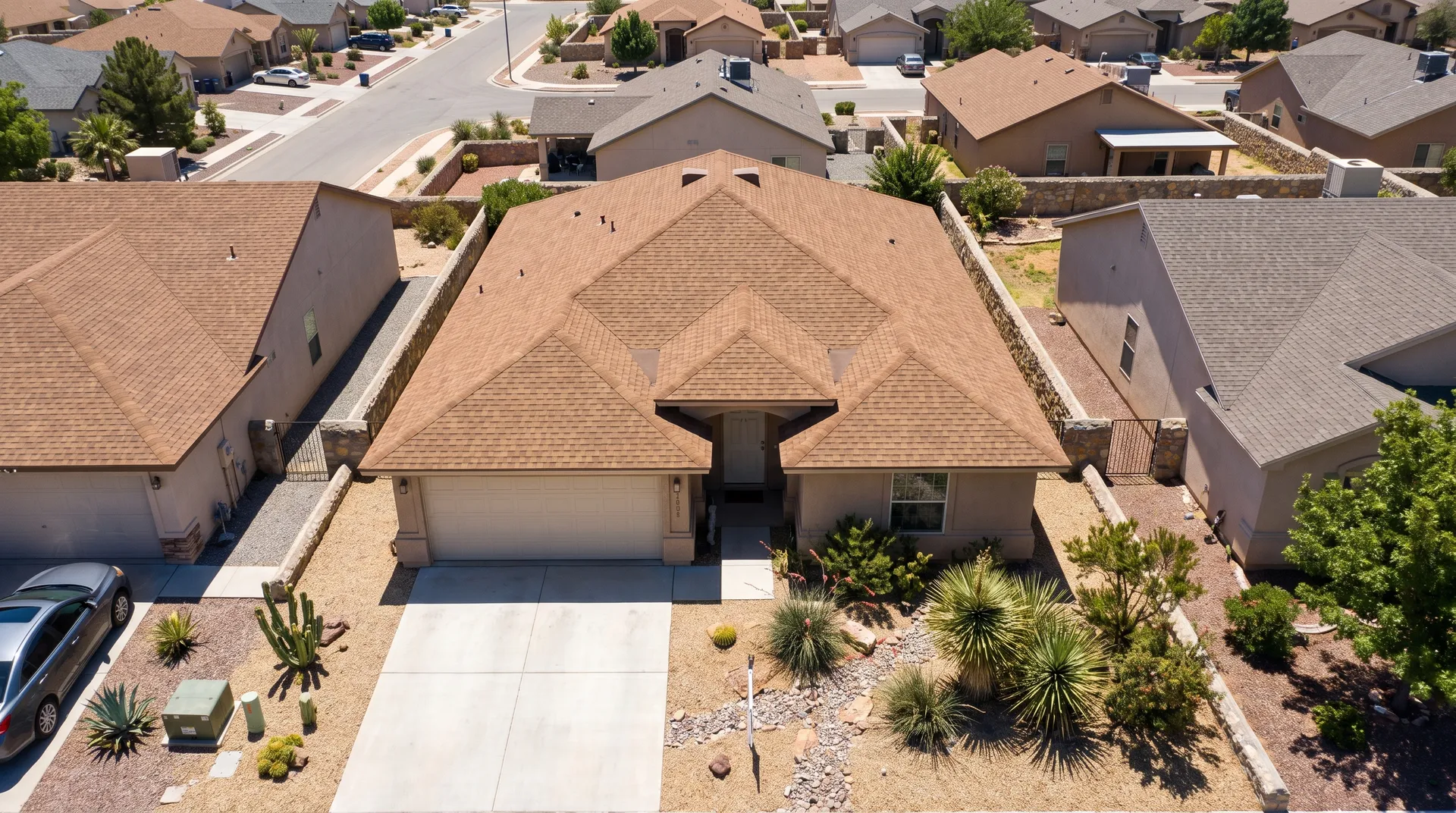
Signs your roof needs replacing, not repairing
A roof earns a replacement when the failure is systemwide rather than in one spot. One missing shingle after a windy night is a repair. A slope that has aged out is not, and the difference is usually visible once somebody gets up there and looks properly.
- Granule loss across whole slopes. The colored grit on an asphalt shingle is its sunscreen. When it washes into the gutters in quantity, the asphalt mat underneath is taking direct UV and the clock speeds up.
- Curling, cupping or cracking. Shingle edges that lift or split have lost their flexibility. That is age and heat rather than damage, and it does not happen in one place only.
- Soft or spongy decking. If the roof gives underfoot, water has been sitting in the structure. That is a tear-off conversation, because the deck itself has to be opened up.
- Leaks in more than one place. A single leak has a single cause. Three leaks in three rooms means the roof surface is no longer keeping water out anywhere reliably.
- A second layer already up there. A roof carrying two layers cannot take a third, and the layer underneath has been hiding the deck for years.
- Daylight or stains in the attic. Look up from inside on a bright day. Light through the deck, dark streaking on the rafters, or damp insulation all say the same thing.
If you are not sure which category you are in, that is exactly what a free roof inspection settles. We would rather do a small honest repair now and be the crew you call when the roof really is finished.
What the 25 percent rule means for a Texas roof
The 25 percent rule comes out of the building code, and it is one of the most misunderstood things in roofing. The principle traces to the reroofing provisions in the International Residential Code (IRC), the model code most Texas cities build their local code from: if more than a quarter of a roof section is repaired or replaced inside any twelve month period, the whole section has to be brought up to current code rather than patched back to whatever it was before.
That matters because codes change. A roof installed decades ago may not meet current requirements for underlayment (the water-resistant layer under the shingles or tile), fastening or flashing (the metal strips that seal the joints around chimneys, vents and walls), and once you cross the threshold you cannot simply reproduce the old assembly. It is one of the practical reasons a very large repair often costs close to what a replacement costs, and why replacement is frequently the better value at that point.
It is not an automatic rule that insurance owes you a new roof once damage reaches a quarter of the roof. That is a separate question and it belongs to your policy and your adjuster, not to us. The code itself is enforced by City of El Paso Development Services, so confirm how it applies to your specific address before you plan around it. What we can tell you is exactly how much of your roof is affected, in writing.
What the El Paso climate does to a roof
El Paso roofs age differently than roofs almost anywhere else in the country, and the reason is not one thing. It is four things happening to the same piece of material in the same year.
- Sun, constantly. El Paso is one of the sunniest cities in the country; it sees sun on most days of the year. UV is the single largest ager of an asphalt roof, and this city delivers more of it than most.
- Real summer heat. Air temperatures over 100 degrees mean roof surface temperatures far above that. Asphalt softens, expands, then cools and contracts, every single day.
- Monsoon rain, June through September. Much of the annual rainfall arrives in a handful of hard, fast storms rather than spread evenly through the year. A roof here sits dry for months and then has to shed a lot of water at once.
- Hail and downburst wind. Those same monsoon cells carry hail and sudden hard gusts that lift and crease shingles instead of tearing them cleanly off.
- Winter freeze and thaw. Desert nights drop below freezing while afternoons stay mild. Any water sitting in a crack expands overnight and widens it, over and over.
The result is a roof that can look completely intact from the street and still fail on the first serious storm of the season. We wrote more about that pattern in why roofs fail faster in El Paso.
Roofing materials that make sense in El Paso
Material choice matters more in this climate than in a mild one, because the failure mode here is heat and UV rather than moisture and moss. Here is what actually goes on roofs in this city, and what each one is good at.
- Architectural asphalt shingles. The most common residential roof in El Paso by a wide margin. Reasonable cost, wide color range, straightforward to repair. The trade-off is that asphalt is the material the sun works on hardest, so ventilation and a quality underlayment matter more here than the brochure suggests.
- Concrete and clay tile. Common on stucco and Southwest-styled homes. Tile handles UV extremely well and lasts a long time. The waterproofing is actually the underlayment beneath the tile, so tile roofs often need that underlayment renewed while the tile itself is still perfectly good.
- Metal, including standing seam. Reflects heat rather than absorbing it, sheds monsoon rain fast, and stands up to wind. Higher cost up front, and it needs correct detailing at every penetration, because metal moves with temperature more than anything else on this list.
- Flat and low-slope membranes. A large share of El Paso homes and small commercial buildings have flat or low-slope sections. TPO and modified bitumen (a rolled asphalt sheet used on flat roofs) are the usual systems. They live or die on seams and drainage rather than on shedding water by gravity.
Many houses here are a mix, for example a pitched shingle main roof over a flat porch or carport section. Those transitions need somebody who works on both kinds of roof. We do.
What actually drives the cost of a roof replacement
We are not going to print a price on this page, and you should be wary of a roofing company that does. The honest answer is that the cost of a roof is set by measurable things about your specific roof, and a number produced before anybody measured them is a marketing figure rather than an estimate.
| Cost driver | Why it moves the number |
|---|---|
| Roof size and pitch | Roofing is priced by roof area, not by house square footage. A steep roof also costs more to work on safely than a walkable one. |
| Material | Asphalt, tile and metal sit at very different price points, and within asphalt there is a real spread between builder-grade and premium lines. |
| Layers to tear off | One layer is one disposal load. Two layers is roughly double the labor and the haul-off before any new material goes on. |
| Decking condition | Nobody can see the deck until the old roof is off. Rotted sheathing has to be replaced, and how much of it there is cannot be known in advance. |
| Complexity | Valleys, hips, dormers, skylights, chimneys and multiple planes all add flashing work, which is the slow and skilled part of the job. |
| Penetrations and accessories | Vents, swamp cooler curbs, satellite mounts and pipe boots each need detailing, and old ones are usually replaced rather than reused. |
| Access | Where a truck and a dumpster can sit relative to the house changes how much of the day is spent carrying material. |
What we do instead of a guessed price is come out, measure, photograph, and hand you a written estimate that breaks the job into line items. That is free, and it is yours to keep and to compare against anyone else. Start it from the free estimate page or call us.
How much roof does a 2,000 square foot house actually have?
This is one of the most searched roofing questions, and the answer is more useful than a dollar figure would be. Roofers measure in squares, where one square equals 100 square feet of roof surface. Critically, roof area is not the same as floor area.
A 2,000 square foot single-story house has more than 2,000 square feet of roof, because the roof is pitched and because of the eave overhangs. Depending on how steep it is, the roof surface commonly works out meaningfully larger than the floor plan underneath it. A 2,000 square foot two-story house is the opposite case: it may have only around half that footprint under roof, so it can need substantially less roofing than a single-story home of the same listed size.
That is why two houses advertised at the same square footage can get very different roofing estimates and both be correct. Pitch, footprint, overhang and complexity decide it. When we measure your roof, we give you the actual square count, so you can compare bids on the same basis instead of on the realtor listing.
Permits and code for a roof replacement in El Paso
A full roof replacement in the city of El Paso is permitted work. That is normal and it is nothing to be nervous about, but it is worth confirming that it is happening, because it is one of the clearest ways to tell a legitimate roofing company from a storm-chaser.
Permit requirements, fees and inspection steps are set by the City of El Paso and can change, so confirm the current requirements for your address with the city, or let us do that as part of the estimate. Homes in Horizon City, Socorro, San Elizario, Clint and Canutillo fall under their own jurisdictions, which is worth knowing if you are outside the city limits.
A permit means an inspection, and an inspection means somebody other than the roofer confirms the work meets code. If a contractor suggests skipping the permit to save you money, understand what is actually being saved: the oversight. It can also become your problem later at resale, when a buyer or their lender asks for records on a roof that has none.
What replacement day looks like
A residential replacement is loud, fast, and over quicker than most people expect. Here is the sequence, so nothing about it surprises you.
- Materials arrive. Shingles or panels are delivered and staged, usually the day before or first thing that morning.
- Protection goes down. Landscaping, walls, windows, patio furniture and anything else in the fall zone gets covered before a single shingle comes off.
- Tear-off. The old roof comes off completely, down to the bare deck. This is the noisiest part of the day and it moves fast.
- Deck inspection and repair. With the deck exposed we walk it and check it. Anything soft, delaminated or rotted gets cut out and replaced, and we show you what we found before covering it back up.
- Underlayment and flashing. New underlayment across the deck, then drip edge, valley metal, and flashing at every wall, chimney, vent and pipe. This is where roofs are actually won or lost.
- The roof surface. Shingles, tile or panels go on to pattern, with correct fastening and correct exposure.
- Ventilation and details. Ridge and intake ventilation, new pipe boots, and the finish detail at every edge.
- Cleanup and magnet sweep. Debris hauled off and a magnetic sweep of the drive, the yard and the street for nails. That is not an add-on charge and it happens before we leave.
Most single-family homes here run one to two days once material is on site. Monsoon weather can add a day, and we would rather lose a day than install a roof over a wet deck.
How to compare roofing bids without getting burned
Get more than one estimate. We mean that. What we ask is that you compare them on the same terms, because the cheapest number on the page is very often the one with the least in it.
- Is it itemized? A real estimate lists tear-off, disposal, underlayment, flashing, material, ventilation and cleanup. A single lump sum hides whatever is missing.
- What happens if the deck is bad? Every honest bid states a per-sheet price for replacing rotted decking, because nobody can see the deck until tear-off. Silence there is a blank check.
- Is new flashing included? Reusing old flashing is a common way to cut a bid and a common source of leaks a year later.
- Same material, same grade? Two bids on asphalt shingles are not comparable if one is a builder-grade three-tab and the other is architectural.
- Is the permit in the bid? It should be named on the page, not left vague.
- Who is doing the work? Ask whether the crew that will be on your roof works for the company whose name is on the contract.
- Is there pressure? A price that expires today is a sales tactic. Roofs do not go on sale for four hours.
The most common way people get hurt here is a door knock after a storm, a huge discount, a deposit, and a company that stops answering. Our estimate is written, it is free, and it does not expire this afternoon. Read who we are before you call anybody, including us.
Looking after a new roof in this climate
A new roof is not maintenance-free, especially here. The habits below cost almost nothing and take very little time, and they are the difference between a roof that reaches the end of its life and one that quits early.
- Look at it twice a year. Once before monsoon season and once after. You are looking for lifted edges, missing pieces, and anything that changed since last time.
- Keep drainage clear. Gutters, scuppers and flat-roof drains full of dust and gravel are how a monsoon storm ends up ponding water on a roof that was designed to shed it.
- Cut back overhanging limbs. Branches abrade the surface in wind and drop debris that holds moisture against the roof.
- Watch the penetrations. Pipe boots and swamp cooler curbs are the first things to crack in the sun, and they are usually a small fix if caught early.
- Get it looked at after hail. Bruising is often invisible from the ground, and documenting it close to the storm date is much easier than proving it later.
If something does go wrong, catch it early. Small problems are roof repairs; the same problem two seasons later usually is not.
Related services
Frequently asked questions
What is the average cost of a new roof in El Paso, Texas?
There is no honest average, because roofs are priced on measurable specifics: roof area and pitch, material, how many layers come off, the condition of the decking, and how many valleys, chimneys and penetrations need flashing. Any company quoting a replacement before seeing your roof is guessing. We measure it, photograph it, and put an itemized number in writing. The inspection and the estimate are both free.
What is the 25 percent rule for roofing?
Covered in detail above. Short version: it is a code requirement, not an insurance guarantee, so confirm how City of El Paso Development Services applies it to your address before you plan a repair budget around it.
How much is a roof for a 2,000 square foot house?
The first thing to know is that 2,000 square feet of house is not 2,000 square feet of roof. A single-story home has more roof than floor because of the pitch and the overhangs, while a two-story home of the same size has roughly half the footprint under roof. Roofers price in squares of 100 square feet of actual roof surface. We measure yours and give you the real square count, so you can compare bids on the same basis.
How do you spot a bad roofing company?
The warning signs are consistent: an unsolicited door knock right after a storm, a price that expires today, a large deposit demanded before any material is delivered, no written itemized estimate, no mention of a permit, and no local address you can actually go to. Ask what happens if the decking is rotted, because a real bid states a per-sheet price. Ask who the crew works for. Then take a day to think about it, because no legitimate roofer will object to that.
How long does a roof last in El Paso?
Usually less than the number printed on the wrapper, for the climate reasons covered above, chief among them El Paso's sun exposure. Ventilation, installation quality and material choice make a real difference. The only way to know where yours actually stands is to have it looked at.
Can you install a new roof over the old one?
It is sometimes permitted, but we do not recommend it, and we will tell you why. Layering over an existing roof means nobody ever looks at the decking, and the decking is where the problems that actually matter hide. It also traps heat against a roof already taking the full El Paso sun, and it makes any future repair harder. Tear-off costs more on the day and less over the life of the roof.
Do I need a permit to replace my roof in El Paso?
Yes, in the city limits, for the reasons covered above. Requirements, fees and process are set by City of El Paso Development Services and can change, so confirm the current rules for your address with the city, or let us handle that as part of the estimate.
Do I need a full replacement or just a repair?
That is the whole point of the free inspection. If the damage is local and the rest of the roof has life left, a repair is the right call and we will say so. If the surface is failing across whole slopes, or the decking is soft, or there are already two layers up there, a repair is money spent twice. You get the answer in writing, along with photographs of what we actually saw.
Get a free estimate
Tell us what is going on and we will come look at it. Straight answer, written price, no pressure.