
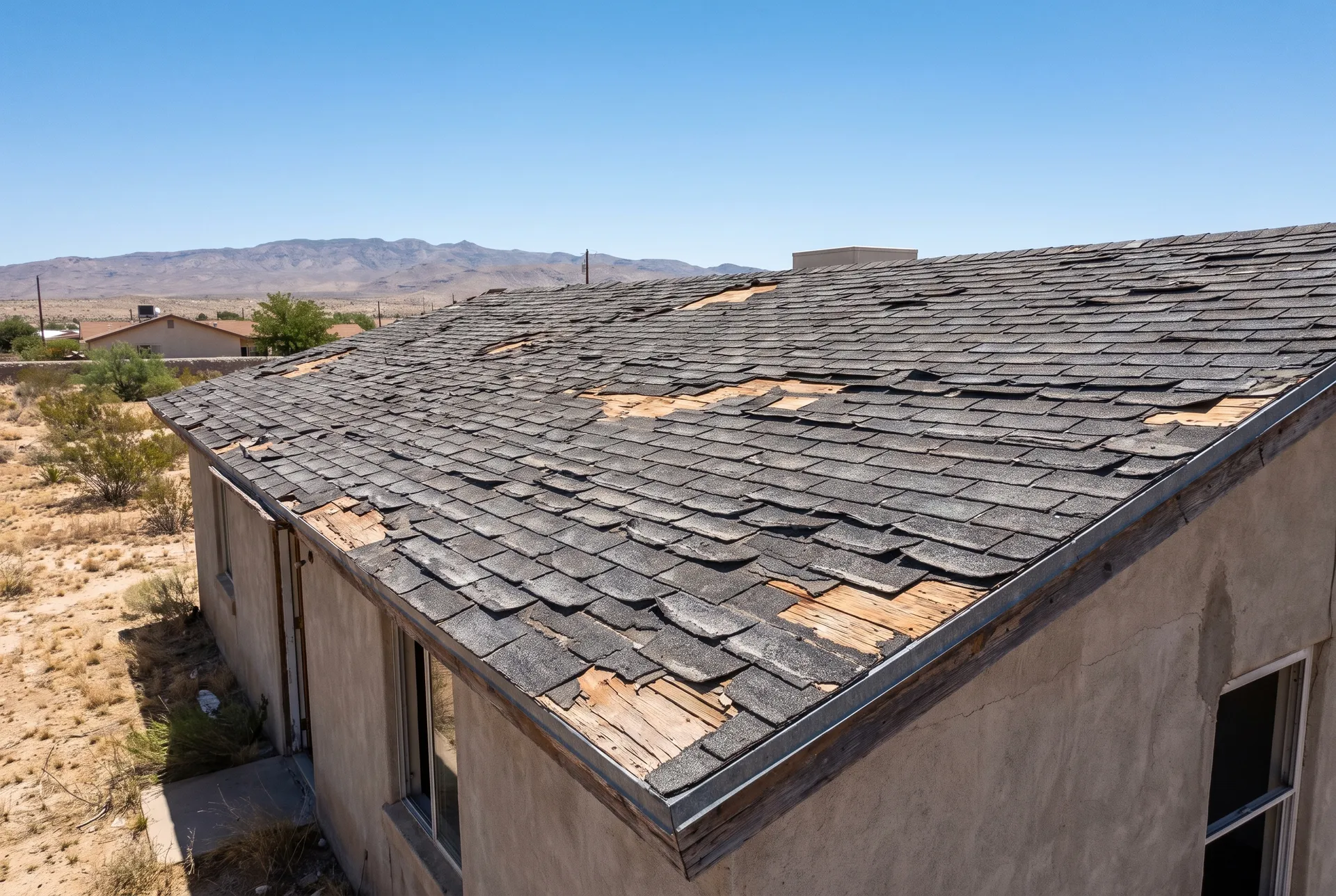
A roof in El Paso ages faster than the same roof would in most other parts of the country, mainly because of two things: nonstop sun exposure and big swings between hot days and cool nights. El Paso averages somewhere around 297 to 302 sunny days a year, which sounds great for your mood and terrible for your shingles.
Most homeowners think about their roof in terms of storms, hail, or leaks. In El Paso, sun damage is doing quiet work in the background every single day the sky is clear, which is most days. Here’s what that actually means for your roof and what you can do about it.
Why Does El Paso’s Sun Wear Out Roofs Faster Than Other Places?
Two things stack on top of each other here. First, the sheer amount of UV exposure. Sun on most days of the year means your shingles are absorbing UV radiation almost constantly, and UV breaks down the oils and asphalt compounds that keep shingles flexible. Second, El Paso’s desert climate produces big temperature swings between day and night.
That swing matters because roofing materials expand when they heat up and contract when they cool down. A roof that goes through a big expansion-contraction cycle every day, on top of constant UV exposure, is working harder than a roof in a milder, cloudier climate. Over time that combination is what shortens a roof’s real-world lifespan compared to what the manufacturer’s warranty assumes, since most warranty testing does not simulate desert-level sun and heat cycling.
What Does UV and Heat Damage Actually Look Like on a Roof?
On asphalt shingles, watch for cracking, curling edges, and granule loss (those little colored granules ending up in your gutters or at the base of downspouts). Granules are not decorative, they protect the asphalt underneath from UV, so losing them speeds up everything else. Shingles that have lost a lot of granules often look faded or patchy compared to when they were new.
On flat or low-slope roofs with a foam or membrane coating, sun damage shows up differently: the coating can dry out, lose flexibility, and develop small cracks or blistering, especially at seams and around penetrations like vents and AC lines. Once a coating loses flexibility, it stops moving with the roof’s daily expansion and contraction, and that is usually where a leak starts.
Does the Temperature Swing Between Day and Night Matter?
Yes, and it is easy to overlook because it is not dramatic like a hailstorm. A shingle or membrane that heats up in the afternoon sun and then cools rapidly after sunset is flexing every single day, all year. That daily stress adds up in a way that a one-time weather event does not. It is part of why two roofs installed the same year, one in a mild coastal climate and one in El Paso, can end up in very different condition after the same number of years.
Three Steps to Slow Down Sun Damage on Your Own Roof
- Check the color and the coating. Lighter shingles reflect more sunlight; a flat roof coating that has gone chalky needs recoating before it cracks, not after.
- Fix ventilation before you fix the surface. Blocked soffit vents or missing ridge vents keep the deck hot after sunset, which adds to the daily stress that ages the material above it.
- Schedule the annual inspection before summer, not after a leak. Catching cracking or curling while it is still a maintenance item is cheaper than catching it as a repair.
How Often Should I Have My Roof Checked in El Paso’s Climate?
Given how much daily sun and heat stress a roof here takes on, an annual roof inspection makes sense even if nothing looks obviously wrong, plus a check after any major storm. The goal is catching cracking, curling, or granule loss early, while it is still a maintenance item, rather than after it has already turned into a leak that damaged the decking underneath.
Can I Do Anything to Slow Down Sun Damage?
A few things genuinely help. Lighter-colored shingles reflect more sunlight and absorb less heat than dark shingles, which can reduce the daily heat stress on the roofing material. Impact-resistant and UV-resistant shingle products are built to hold up longer under exactly these conditions, and while they cost more up front, they are worth asking about if you are already due for a roof replacement. On flat roofs, keeping the coating maintained and reapplied on schedule protects the membrane underneath from taking direct UV exposure. None of this stops the aging process entirely. It just slows it down and buys you more years before replacement.
When Is Sun Damage Bad Enough to Need a Full Replacement?
If you are seeing widespread cracking or curling across the roof rather than in one isolated spot, heavy and consistent granule loss, or a flat roof coating that has cracked or lost adhesion in multiple areas, that is usually past the point where patching makes sense. Isolated damage in one section can often be repaired. Widespread wear across the whole roof from years of sun exposure is a different conversation, and it is worth getting an honest opinion on which situation you are actually in before you spend money either way.
A Twenty Minute Ground Level Check You Can Do Yourself
You do not need to climb anything to learn most of what a homeowner needs to know. Pick a clear morning, walk the whole perimeter of the house, and work through this list. Take photographs as you go so you can compare next year.
- Look in the gutters and at the bottom of every downspout. A layer of granules that looks like coarse sand is the roof telling you its UV protection is leaving.
- Sight along each roof edge from the corner of the yard. Curling shows up as a wavy line where a straight one should be, and it is far easier to see from an angle than from directly below.
- Compare the slopes. The south and west faces take the most sun in El Paso and almost always age first. If one slope looks noticeably more faded or patchy than the others, that is UV wear rather than a defect.
- Check the ridges and the hips. Ridge caps are bent shingles, which means they are the first thing to crack when the material goes brittle.
- Look at every penetration you can see. Vents, pipes, the swamp cooler, AC lines. You are looking for lifted metal, rust, or sealant that has pulled away.
- Walk the ceilings inside, including closets and the garage, and note any stain even if it is dry.
- Look at the attic with a flashlight if you can get in. Daylight through the decking, dark streaks down the rafters, or crisp lines of dust on the insulation all mean air and water are getting in somewhere.
Anything on that list is worth a photograph and a phone call. None of it is worth climbing a ladder for.
Which Roofing Materials Hold Up Best Under El Paso Sun
There is no material that ignores this climate, but they fail in different ways and at different speeds.
Three-tab asphalt shingles are the cheapest to install and the first to go. They are thin, they lose granules quickly under constant UV, and they curl at the edges once the asphalt dries out.
Architectural or laminate shingles carry more material and hold their granules longer, and the impact-resistant lines add a reinforced mat that also helps against hail. Colour matters here more than people expect: a lighter shingle reflects more of the load instead of absorbing it, which lowers the daily heat cycling the whole assembly goes through.
Standing seam metal handles UV and heat cycling well, and reflective finishes handle it better still. The thing to get right is the detailing, because metal moves noticeably as it heats and cools and the fasteners and flashing have to be built to allow that.
Flat and low-slope coatings and membranes live or die on maintenance. Kept sealed and recoated on schedule, they do fine. Left alone through a decade of El Paso sun, the coating goes chalky, loses flexibility, and cracks at exactly the seams and penetrations where water is waiting.
Whatever goes on, the underlayment, the flashing (the metal strips that seal the joints around chimneys, vents and walls) and the ventilation matter as much as the surface. A premium shingle over failed flashing still leaks.
Shingle Types Compared for El Paso Sun
The material list above described how each option ages. Side by side, the tradeoff looks like this.
| Material | Upfront cost | Sun resistance here | Worth knowing |
|---|---|---|---|
| Three-tab asphalt | Lowest | Weakest, loses granules fastest | Cheapest to replace when it fails, but fails soonest |
| Architectural / laminate | Mid | Better granule retention, impact-resistant lines available | The reasonable default for most El Paso re-roofs |
| Standing seam metal | Highest | Strongest, especially with a reflective finish | Detailing at fasteners and flashing matters more than the panel itself |
| Flat roof coating/membrane | Varies by system | Only as good as the maintenance schedule | Neglect, not material choice, is the main failure cause |
None of these is immune to the climate. The table is about which one buys you the most years for the money, not which one lasts forever.
Attic Heat and Ventilation
Most conversations about roof lifespan stop at the surface, which misses half the problem. A roof cooks from underneath as well as from above.
When an attic has too little intake ventilation at the eaves or too little exhaust at the ridge, heat builds under the decking and stays there through the evening. That keeps the shingles hotter for longer each day and raises the whole assembly’s temperature swing, which is the exact stress that ages roofing material here. It also drives your cooling bill up while it does it.
Signs worth mentioning to whoever inspects the roof: blocked or painted-over soffit vents, insulation stuffed into the eaves where the air is supposed to come in, no ridge or static vents at all on a large roof, or an attic that is dramatically hotter than the outside air well after sunset.
Ventilation is usually a modest job compared with a roof, and it is one of the few things that genuinely buys extra years rather than just delaying a decision.
A Year of Roof Maintenance in El Paso
Nothing here is expensive, and doing it is the difference between a roof that reaches its rated life and one that does not.
Spring. Get the annual inspection done while roofers are not buried in storm calls. Address anything found while it is still a maintenance item.
Before June. Clear the drains, scuppers and gutters by hand. Re-seal cracked or shrunken sealant at every penetration. Trim back overhanging limbs. Photograph the roof in known good condition.
Through the summer. After any hard storm, walk the ceilings inside and look at the ground outside for granules or debris. Stay off a wet roof.
Autumn. Fix whatever the season exposed while it is dry. This is also the sensible time to do a roof replacement if you have decided you need one, rather than trying to schedule it during monsoon season.
Winter. Quiet months. Good time to read your policy, check your warranty terms, and get bids without a deadline attached.
What to Ask Before You Sign for a Replacement
If the sun has finally taken your roof, the decision worth getting right is not who is cheapest but who is quoting the same work. Ask every bidder:
- Is this a full tear-off, or is the plan to go over the existing roof?
- What happens to decking that turns out to be soft once it is opened up, and what does that cost per sheet?
- Which shingle, coating or panel, named by manufacturer and product line, and what is its rating for this climate?
- Are underlayment, drip edge, valley metal and new flashing itemized, or reused?
- Are the vents and pipe boots being replaced or resealed?
- Is any ventilation work included, and if not, why not?
- Who pulls the permit and who hauls the debris?
- What is the workmanship warranty in writing, and is it separate from the manufacturer’s material warranty?
Ask for current license and insurance documents from all of them, ours included, and read what you are handed. A written scope you can compare line by line is worth more than any promise made in your driveway. Start with a free written estimate, then use it to judge the others.
Frequently Asked Questions
Does the color of my shingles actually make a difference in a climate like El Paso’s? Yes. Lighter colors reflect more sunlight and stay cooler than dark shingles, which reduces the daily heat and expansion stress on the roof. It will not eliminate sun damage, but it does slow it down.
How do I know if it’s sun damage or storm damage? Sun and heat damage tends to be spread evenly across the roof and shows up gradually as cracking, curling, or fading. Storm damage, especially hail, tends to be more scattered and shows up suddenly, often paired with dents on gutters or the AC unit. A trained eye can usually tell the difference on inspection.
Is a flat roof or a pitched roof better for El Paso’s sun exposure? Both take UV exposure, just differently. Pitched roofs shed heat somewhat and are straightforward to inspect visually. Flat roofs need their protective coating maintained on schedule since the coating is the main thing standing between the sun and the membrane underneath. Neither is immune, they just need to be watched differently.
Can sun damage void my roof’s warranty? That depends on the manufacturer and the specific warranty terms, which is worth reading closely rather than assuming. Regular maintenance and inspections are generally what keep a warranty valid, so staying on top of inspections protects both the roof and the warranty.
If your roof has been sitting under El Paso sun for a few years and you are not sure what kind of shape it is really in, Roofing Pros EPTX will inspect it and tell you honestly what we see, no pressure to replace something that just needs maintenance. Call (915) 222-2924 or request a free estimate to schedule a look.