
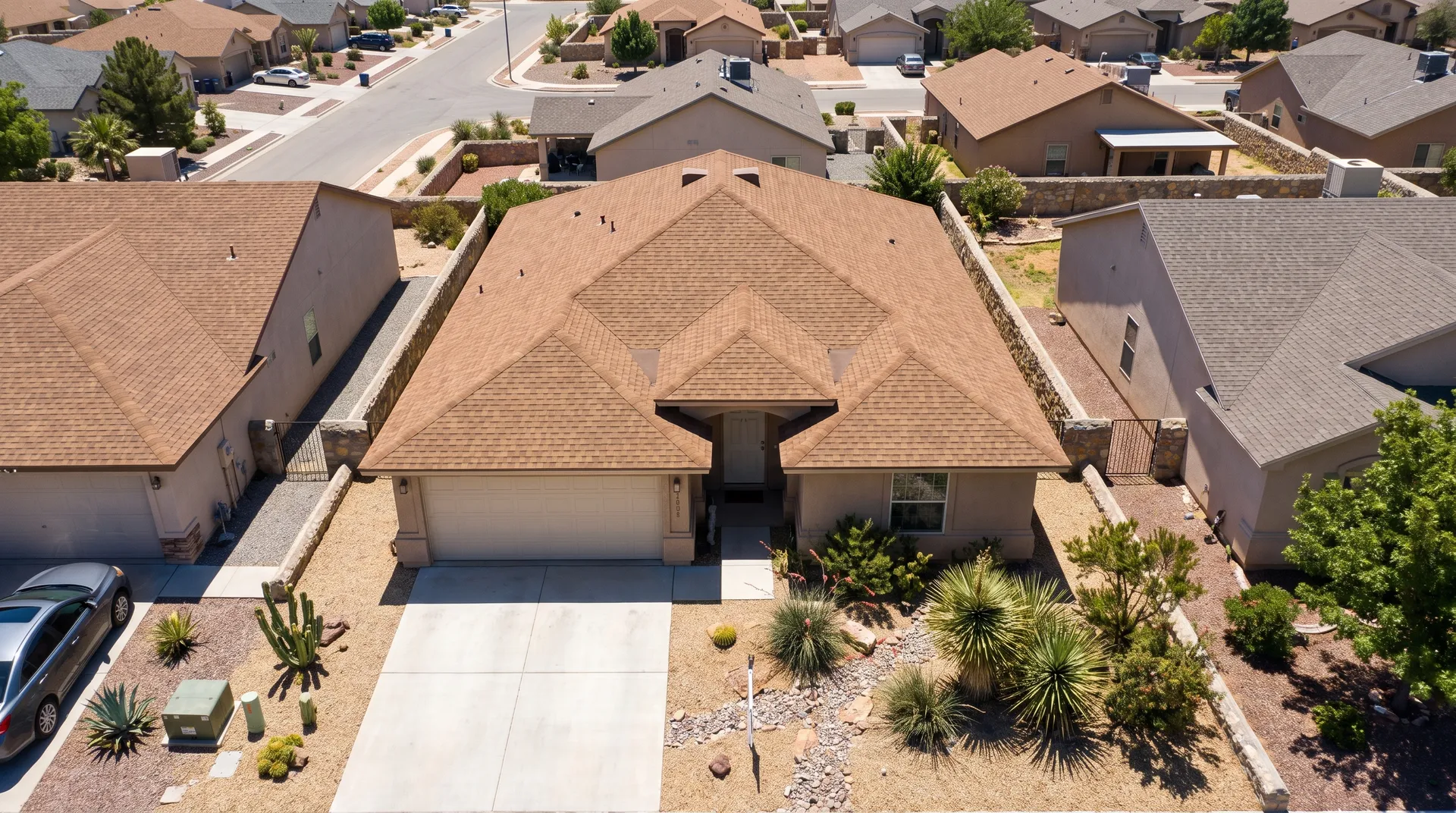
For most El Paso homeowners, a pitched roof is the more forgiving choice and a flat roof is the more demanding one. A pitched roof sheds a monsoon downpour by shape alone, while a flat roof only works as long as its drains, seams and surface stay in good condition. Neither is wrong for this city, though. Both are common here, and a well kept flat roof will outlast a neglected pitched one every time.
The real question is rarely “which type is better in the abstract.” It is usually “I already have one of these, or I am adding a room, so what does it need from me?” This guide compares the two on the things that matter in El Paso: water, sun, wind, hail, upkeep and repair. Where a roofing term shows up, it gets a plain explanation the first time.
How Do Flat and Pitched Roofs Differ in Plain Terms?
A pitched roof slopes enough that rain runs off on its own. It is covered in overlapping pieces, most often asphalt shingles, clay or concrete tile, or metal panels. Each piece sheds water onto the one below it, so the roof works like a set of layers rather than one sealed skin.
A flat roof, which roofers more accurately call a low-slope roof, has only a slight tilt, just enough to point water toward a drain. Because water moves slowly across it, the surface has to be one continuous waterproof layer instead of overlapping pieces. That layer is often a rolled or sprayed membrane (a sheet or coating that acts as one seamless skin), sometimes finished with a reflective coating on top.
That single difference drives almost everything else. A pitched roof relies on gravity and overlap. A flat roof relies on a continuous surface and a working drain.
Which Handles El Paso Monsoon Rain Better?
Monsoon season is El Paso’s summer rain season, and it brings short, heavy downpours instead of steady drizzle. That favors the pitched roof, because shape moves the water off quickly no matter how hard it is falling.
A flat roof has to move the same water through its drains and scuppers. A scupper is an opening cut through the low wall around the roof edge (that wall is called a parapet) so water can pour out the side. When wind-blown desert dust packs into a drain or scupper, water stops leaving and starts pooling. That is ponding, which means water standing in one place on the roof instead of draining away. Water that sits finds every weak seam.
So the monsoon comparison comes down to this: a pitched roof asks little of you before the rain, and a flat roof asks you to clear its drains and check its seams first. Our post on how monsoon season causes roof leaks walks through that pre-rain routine.
Which Handles Sun and Heat Better?
Neither type escapes the sun. El Paso is one of the sunniest cities in the country, and ultraviolet light is the single biggest ager of most roof surfaces. What differs is where the damage shows up.
On a pitched asphalt roof, sun slowly dries out the shingles until they curl, crack or shed their surface grit. On a flat roof, sun attacks the membrane and any coating on it, which can chalk, blister or split along seams as the surface expands in the afternoon and shrinks overnight.
Color and finish matter more on a flat roof, because the whole surface faces the sky and absorbs heat all day. A light, reflective finish keeps that surface cooler. Pitched roofs also benefit from lighter colors, but the sloped surface meets the sun at a changing angle, so the effect is less dramatic.
How Does Hail Treat Each One?
Hail is less frequent here than sun or wind, but when it comes it arrives with the same monsoon storms, and it hits the two roof types differently.
On a pitched roof, hail bruises or cracks shingles and can crack tile. The damage is spread across the slopes, and it often shows up as scattered dents, missing surface grit or cracked pieces that a trained eye can read from above.
On a flat roof, hail can puncture or fracture the membrane and the coating. Because the roof is one continuous layer, a single break can let water reach the layers below, and water that gets under a flat membrane can travel a long way before it shows up as a ceiling stain.
If hail has come through, our storm and hail damage page explains what we look for, and the post on hail damage and insurance claims covers the paperwork side.
Where Does Each Roof Type Usually Fail First?
Roofs fail at their weakest detail, not across the whole surface at once. Knowing where to look is half the maintenance. One word in the table below needs explaining first: flashing is the metal strip that bridges the joint where a roof meets a wall, a chimney or a vent pipe.
| Flat or low-slope roof | Pitched roof | |
|---|---|---|
| First place to fail | Seams in the membrane, drains and scuppers, and the edges where the roof meets a wall | Shingle or tile edges, ridges, and flashing around chimneys and vents |
| Main cause | Ponding water, cracked coating, sun-hardened material | Wind lifting edges, sun drying out the surface, loose or dried-out flashing |
| What a leak looks like | A stain far from the actual entry point, because water travels under the membrane | A stain below the failed spot, often near a wall, chimney or vent |
| What it asks of the owner | Clear drains before monsoon season, watch for low spots, keep the coating intact | Check edges and flashing, clear gutters, watch for loose or missing pieces |
Flashing is simple to make and easy to ignore, and on a pitched roof it is where a lot of leaks begin.
What Does Each Type Ask of You Over the Years?
Upkeep is where flat and pitched roofs really separate.
A pitched roof can go a long time with light attention. A yearly look for lifted shingles, cracked sealant and clogged gutters catches most problems early, and much of that can be spotted from the ground with a pair of binoculars.
A flat roof wants more frequent attention. Drains need clearing, seams need checking, and the coating needs to stay intact because it is the roof’s protection against sun. Skipping a season on a flat roof is a bigger gamble than skipping one on a pitched roof, because the margin for error is smaller. Our roof maintenance page describes the kind of regular inspection that keeps small items small.
None of this means a flat roof is a bad choice. It means a flat roof is a roof you maintain, while a pitched roof is a roof you check on.
Which Is Easier to Repair?
We do not quote prices in a blog post, because the right number depends on the roof in front of us. We give a free written estimate after an inspection, and that estimate is where a cost belongs.
What can be said in general is how the repairs differ. A pitched roof repair is often a matter of replacing damaged pieces and resealing flashing, and the work is visible and local. A flat roof repair starts with finding the real entry point, which can be well away from the stain, and then repairing the membrane, the seam or the drain detail, and correcting whatever let water sit in the first place. Patching a flat roof without fixing the ponding that caused the failure tends to bring the leak back.
If you already know you have a flat roof with trouble, our flat roof repair page covers how we approach it. For a sloped roof, see roof repair.
Can You Change One Into the Other?
Sometimes, but it is a construction project and not a roofing swap. Converting a flat roof to a pitched one means framing a new sloped structure over the old one, which is carpentry work first and roofing work second. Framing is the structural wood skeleton of a building, and our carpentry and framing page covers that side of the work. It is one reason a company that does both roofing and framing can be a useful fit for this question.
Going the other way, from pitched to flat, is rare and usually done only on an addition or a small structure.
Most homeowners do not change the roof type. They replace what they have with the same type, or choose a different covering on the same shape. If a full roof replacement is on the table, the decision is usually about the covering and the details, not the shape.
What About Additions and New Construction?
Roof shape often follows the house. A flat or low-slope roof is common on older homes in El Paso, on garages, porches and small commercial buildings, and on additions that need to tie into an existing wall without raising the ridge line (the peak where two roof slopes meet). A pitched roof is common on newer housing and wherever the owner wants a more traditional look.
When you add a room, the new roof has to meet the old one, and that joint is where leaks like to start. Plan the roof and the addition together instead of treating the roof as an afterthought. With a remodel or addition handled by one crew, the framing, roofing and flashing are planned together and nobody is pointing at someone else when a joint leaks.
A Quick Checklist for Choosing
Use these questions in order. They narrow the choice faster than a pros-and-cons list.
- What do you already have? Replacing like with like is usually simpler than changing shape.
- Who will look after it? A flat roof needs regular drain checks and seam inspections. If that will not happen, lean pitched.
- How much rain does the building have to shed? Heavy monsoon runoff is an argument for slope.
- Is there a parapet or wall around the roof edge? If so, you have scuppers (the drain openings through that wall), and they need clearing.
- What is the roof attached to? An addition tying into an existing wall can limit your choices.
- Has hail or storm damage already tested it? A roof that has taken a hit should be inspected before you decide anything.
Frequently Asked Questions
Is a flat roof a bad idea in a monsoon climate? Not by itself. A flat roof with clear drains, sound seams and an intact coating handles monsoon rain fine. The trouble comes when dust blocks the drains and water sits. The roof type is not the problem; neglect is.
Do flat roofs always leak? No. A flat roof leaks when something has failed, usually a seam, a drain detail or a coating that has been left to break down. Many flat roofs stay dry for a long time with regular attention.
Can I tell what kind of roof I have from the ground? Usually. If you can see roofing pieces such as shingles or tile sloping away from you, it is pitched. If a wall rises around the edge and you cannot see the surface, it is likely flat or low-slope. When in doubt, a quick look from a ladder at the eave, the lower edge of the roof, will settle it.
Does roof shape affect how hail damage gets found? Yes. Sloped roofs show damage across the slopes, while flat roofs hide damage under a continuous surface, so a flat roof often needs a closer, hands-on look.
Which is better for a home addition? It depends on how the addition meets the existing house. The best choice is the one that ties into the existing roof with the fewest awkward joints, and that is a framing decision as much as a roofing one.
If you are weighing a repair, a replacement or an addition and want someone to look at the actual roof, Roofing Pros EPTX will come out for a free inspection and give you a written estimate. Call (915) 222-2924 or request a free estimate.