
El Paso roofers: two brothers, one crew, one standard
Roofing Pros EPTX is a locally owned roofing and construction company in El Paso, Texas, run by two brothers with 20 years of combined experience in the trades. We handle roof replacement, repair, storm damage and carpentry with one crew, free written estimates, and 24 hour service. The company is new. The hands are not.
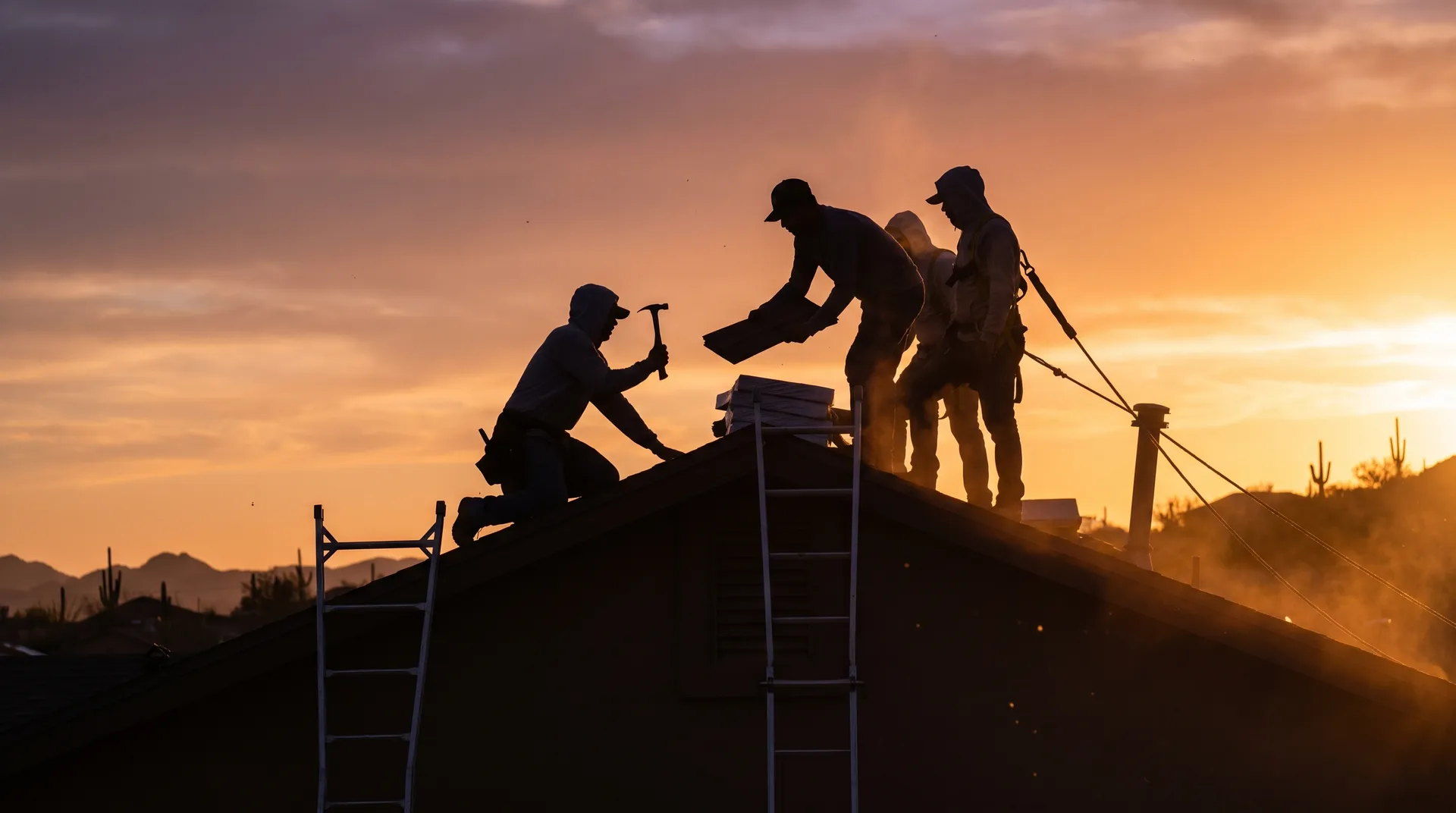
We are new, and we are not pretending otherwise
Plenty of contractors in this city would quietly let you assume the company has been around for decades. We would rather say it plainly: we started this company recently, after twenty years between us working roofs and job sites for other people. We decided we would rather answer for the work ourselves.
What that means for you is simple. Every job right now is a job we cannot afford to do badly. There is no back catalogue to coast on and no volume to hide a bad week in. The two of us are on the roof, our name is on the estimate, and there is nobody above us to escalate to if something goes sideways, because we are the top of the ladder.
It also means we are asking you to judge us on something other than a wall of reviews we have not earned yet. So judge the estimate. Ask us to walk you through what we found and why we priced it the way we did. Ask what we would do if it were our own house. A written scope from somebody who actually got on the roof tells you more about a contractor than a decade of advertising does.
Carpenters first
We came up as carpenters, which is not the usual route into roofing and it changes how we work. A carpenter looks at a failing roof and thinks about the structure underneath it, not only the surface on top. Soft decking, a rotted rafter tail, a joint that was never framed right in the first place.
That habit catches things a surface-only crew has no reason to look for. A low spot on a flat roof is usually a drainage problem, but sometimes it is a member that has started to sag, and coating over it just gives the water a smoother place to sit. A ceiling stain three feet from the wall is often a flashing failure at the wall, because water runs along framing before it drips. Knowing how the building was put together is how you find where the water actually got in.
It is also why we can take a project from framing through the roof to finish without handing you off to somebody else halfway through.
How we work, step by step
There are four steps and none of them involve a sales pitch at your kitchen table.
- You call. Tell us what you are seeing, or what you are planning to build. If water is coming in right now, say so, because that changes the order we come out in.
- We inspect it for free. We get on the roof where it is safe to do that, rather than judging it from the driveway. We photograph what we find, and we show you the photographs whether or not you end up hiring us.
- You get a written estimate. Scope, materials, and the number, on paper. It is a document you can hold us to and compare against anyone else in town.
- We do the work and clean up. One crew from the first tear-off to the last magnet pass over your driveway.
There is no pressure step in that list on purpose. Take the estimate, sit on it, get two more. The whole point of putting it in writing is that it still says the same thing next week.
What is in the written estimate
A number on its own is not an estimate, it is a guess with a dollar sign in front of it. Ours spells out the scope so you can see exactly what you are buying and exactly where another bid differs.
- Whether the job is a tear-off or a repair, and what area it covers
- What happens to decking that turns out to be soft once we open it up, and what that costs per sheet
- Underlayment, drip edge, valley metal and flashing, listed rather than assumed
- The specific material going on, by manufacturer and product line
- Which vents, boots and penetrations are being replaced instead of resealed
- Who pulls the permit and who hauls the debris off your property
- The workmanship warranty, in writing and separate from the manufacturer's material warranty
If you are collecting bids, put ours next to the others line by line. Big price gaps between roofers almost always come from a difference in scope rather than a difference in greed, and a scope you can read is the only way to see it. There is more on that in our guide to roof replacement and in the comparison notes on the home page.
What we will not do
This list matters more than the usual promises, because it is the part of the industry that gives roofing its reputation in this city.
- We will not invent damage. If the roof has four good years left, we will tell you it has four good years left, and we will show you the photographs that say so. Selling a replacement to somebody who needs a repair is the fastest way to be finished in a town this size.
- We will not layer new material over bad decking. Going over the top is cheaper on the day and it buries the problem where you cannot see it rot. If the deck is soft, it comes out.
- We will not pressure you. No today-only price, no signature required before we leave, no discount that evaporates if you want to think about it. If a price is fair on Tuesday it is fair on Friday.
- We will not touch your deductible. Waiving, rebating or absorbing an insurance deductible is illegal in Texas. Anyone offering that after a hailstorm is telling you what kind of operation they run.
- We will not leave a mess. Nails, debris and offcuts go with us. That sounds small until you have pulled a roofing nail out of a tire.
Why roofing and construction under one roof helps you
Most homeowners meet this problem the first time a job crosses a trade boundary. The roofer says the framing is the framer's problem. The framer says the leak is the roofer's problem. You stand in the middle holding two phone numbers and a wet ceiling.
Because we do both, that argument has nowhere to go. An addition and the roof over it are quoted together, scheduled together, and built by the same people, so the tie-in where the new roof meets the old one is somebody's responsibility from the start. Rotten eaves and fascia get rebuilt properly while the roof is open, which is the only sensible time to do it. Storm work that turns out to involve structure does not need a second contractor and a second wait.
It shows up in the small jobs too. A patio cover, a rebuilt carport, a garage conversion, a deck. See remodels and additions, carpentry and framing, and site work and cleanup for what that side of the business covers.
Built around how El Paso actually treats a roof
Roofing here is its own problem. Sun on most days of the year means ultraviolet exposure dries the flexibility out of shingles and coatings, and the desert temperature swing between afternoon and small hours works every joint on the building loose a fraction at a time. Then monsoon season arrives between June and September and delivers most of the year's rain in short, hard bursts driven sideways by wind.
The flat and low-slope roofs all over this city fail in their own way. Nine months of wind-blown dust packs the drains, scuppers and gutters solid, and the first real storm turns that dust to paste and plugs them completely. Water that cannot leave sits, and standing water finds every seam it is resting on.
Knowing that is the difference between quoting a roof and reading one. It is why we look at drains and penetrations before we look at anything cosmetic, and why we push annual inspections before June rather than repairs in July. We wrote both problems up in full: why roofs fail faster in El Paso sun, and how monsoon season causes leaks.
Tear-off vs. overlay: two words worth knowing before you get a bid
Contractors use these two terms constantly and rarely stop to define them, so here is the difference in plain language.
| Tear-off | Overlay | |
|---|---|---|
| What happens | Old roofing material comes off down to the decking before new material goes on | New material is laid directly over the existing layer |
| What it hides | Nothing; the decking is visible and any soft spots get found and fixed | Soft or damaged decking underneath, which keeps rotting out of sight |
| Where we stand | What we do on every job | What we will not do, described in the list below |
Licensing, insurance and paperwork
Ask us for our current license and insurance documents when we come out. We will hand them over and give you the time to read them, and we would rather you did that than took our word for it.
Ask every contractor the same thing, and be specific about it. You want to see current dates, not a photograph of something from two years ago, and you want the certificate to name the company that is actually doing your work rather than a related name you have never heard. This is a normal request and nobody legitimate is offended by it. The reaction you get to asking is itself useful information.
The same goes for the permit. On work that needs one, ask who is pulling it and in whose name, and keep the paperwork when the job closes out. Hold on to your written estimate, the before and after photographs, and the workmanship warranty together in one place. If you ever sell the house, or ever have to make a claim on that roof, the folder is worth more than anything either of us can remember about the job years later.
Where we work
El Paso and the surrounding area, residential and commercial. That includes Horizon City, Socorro, San Elizario, Canutillo, Clint, and Fort Bliss and Northeast El Paso.
Local is not a slogan on this one. Roofs on the open east side take wind that houses tucked behind the ridge never see, the lower valley sits on different ground, and a lot of the flat roofs in the older central neighborhoods need their drains cleared far more than they need a new roof. If you are just outside the list, call anyway and we will tell you honestly whether we can get to you. The full map is at service areas.
How to reach us
Call (915) 222-2924. We run 24 hour service, so an active leak or storm damage in the middle of the night is a call we expect to get, and stopping the damage tonight is cheaper for you than replacing wet framing later.
If it can wait for daylight, request an estimate and tell us what you are seeing, or use the contact page. Either way somebody comes out, gets on the roof, and gives you the answer in writing.
What we do
Frequently asked questions
How long have you been doing this?
Twenty years combined between the two of us in the trades. The company itself is new, and we would rather tell you that straight than dress it up.
Are you licensed and insured?
Ask us for our current license and insurance documents when we come out and we will put them in your hand. You should be asking that of every contractor who knocks on your door, and you should be reading what you are handed rather than taking the answer on trust.
Do you do both roofing and construction?
Both, with the same crew. We are carpenters as well as roofers, which is why an addition and the roof that goes over it are one conversation here.
Do you charge for an estimate?
No. There is no trip charge and no inspection fee. We come out, look at the roof or the project properly, and give you the scope and the number in writing at no cost and with no obligation to use us.
Who is actually going to be at my house?
Us and our crew, on the same job, start to finish. We do not sell the job and hand it to a subcontractor you have never met, and you will not be talking to a call center when you want to know what is happening.
Why should I hire a new company?
Because the hands are not new and because every job we do right now matters more to us than it would to a company with a back catalogue to coast on. If that is not enough for you, that is a fair position. Get our written estimate anyway and use it to judge the others.
Get a free estimate
Tell us what is going on and we will come look at it. Straight answer, written price, no pressure.