
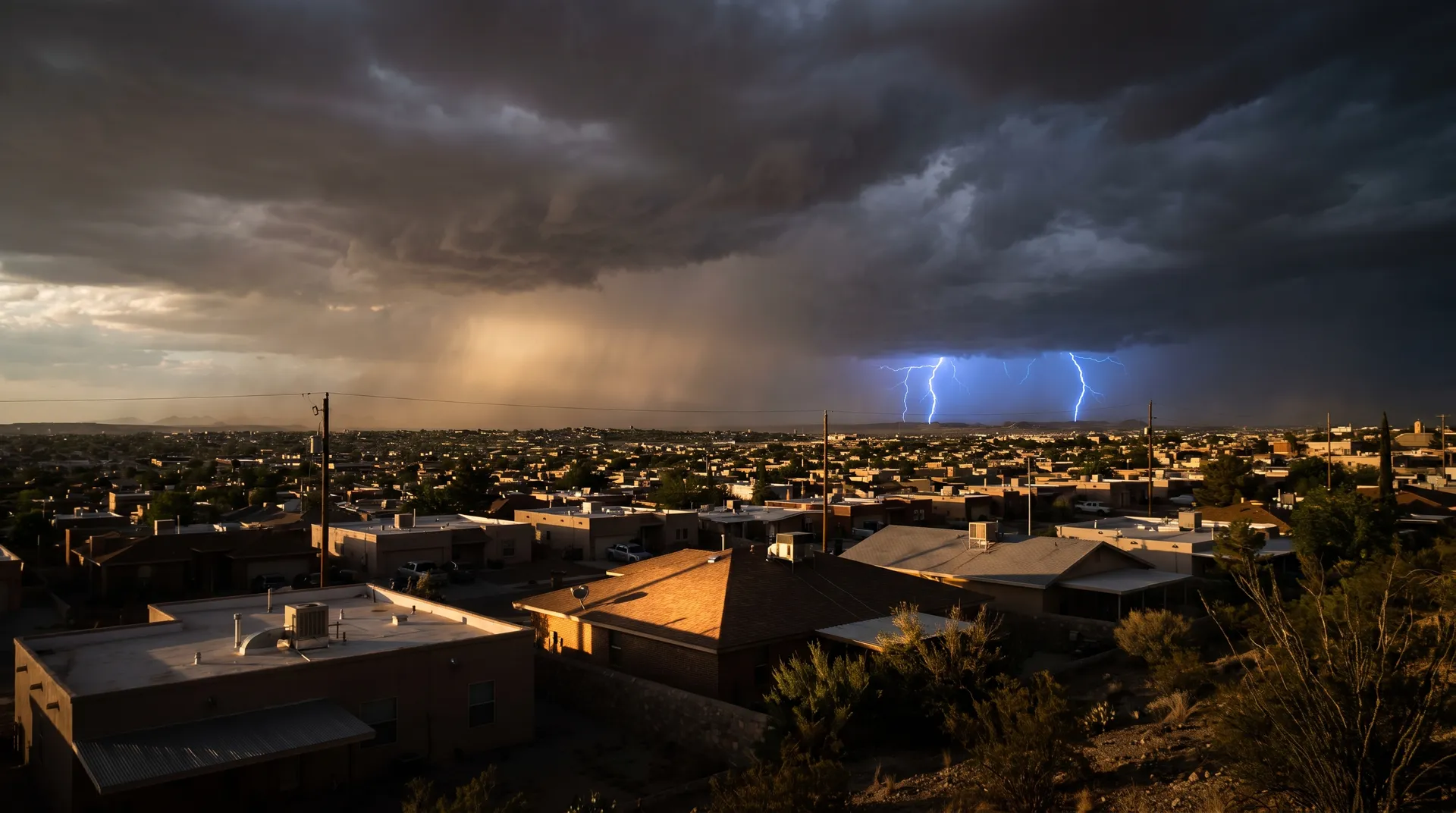
If your roof only leaks after a hard rain, the rain is not really the problem. Nine times out of ten the roof was already compromised by nine months of sun, and monsoon season is simply the first thing all year that tests it with real water. That is why so many El Paso homeowners go from a dry ceiling in May to a stain in the hallway in July without anything obvious happening in between.
Monsoon season here runs roughly from mid June through the end of September, and it delivers most of the year’s rain in short, violent bursts rather than steady drizzle. A roof that would shrug off an hour of light rain can be overwhelmed by twenty minutes of that. Here is what actually goes wrong, and what you can do before the next storm.
Why Does My Roof Only Leak During Monsoon Season?
Because monsoon rain is a different kind of test. Two things make it harder on a roof than ordinary rain.
The first is volume in a short window. Water arrives faster than the roof can move it, so instead of running off, it backs up. Backed-up water sits, and sitting water finds every seam, nail hole, and lifted edge that running water would have skipped past.
The second is wind. Monsoon storms in El Paso usually arrive with a wall of wind and dust ahead of the rain. Wind-driven rain does not fall down onto your roof, it comes in sideways, underneath shingle edges and behind flashing (the metal strips that seal the joints around chimneys, vents and walls) that was only ever designed to shed water coming from above.
How Does Dust Clog Roof Drains and Scuppers?
This is the El Paso specific failure that catches people out, and it is most common on flat and low-slope roofs, which are everywhere in this city.
For nine months a year, wind carries dust and grit onto your roof. It settles in the low spots, in the gravel, around the drain baskets, and inside the scupper openings at the parapet wall. It does not look like much. Then the first monsoon storm hits, the dust turns to a heavy paste, and it packs solid right where the water is supposed to leave.
Now your flat roof is a shallow pool. Every weak seam is submerged instead of merely wet. This is where ponding does its damage: standing water adds real weight, works its way into any crack in the coating, and speeds up the breakdown of the material underneath it.
A drain that is half blocked is enough. It does not have to be sealed shut to be a problem.
Why Does Sun-Dried Flashing Leak the Moment It Rains?
Flashing and sealant are the parts of a roof that take the most punishment from our climate and get looked at the least.
Flashing is the metal that bridges the joints: where the roof meets a wall, around the chimney, around vent pipes, and around swamp cooler and AC penetrations. Swamp cooler curbs deserve extra attention here, because they are cut through the roof and get walked around every service call. Sealant is what closes the last gap. Both spend the dry months baking. UV exposure and the big day-to-night temperature swings in the desert dry sealant out, shrink it, and crack it, while the metal underneath expands and contracts every single day and slowly works its fasteners loose.
By June you can have flashing that looks intact from ten feet away but has a hairline gap running along the top edge, and caulk that has pulled away from the metal in a line so thin you would not notice it. Neither one matters at all until water is being driven at it sideways at high volume. Then it matters immediately.
What Are the Signs My Roof Is About to Leak?
Look for these before the rain, not after:
- Cracked, shrunken, or pulled-away sealant around vents, pipes, and wall joints
- Flashing with lifted edges, rust, or loose fasteners
- A drain basket or scupper packed with dust, gravel, or debris
- Low spots on a flat roof where dried dirt outlines an old puddle
- Blistering, cracking, or chalky patches in a flat roof coating
- Curling, cracked, or missing shingles, especially along edges and ridges
- Stains on ceilings or the top of interior walls from a previous storm you never traced
That last one is worth taking seriously. A stain that appeared once and then dried is not a resolved problem. It is a leak waiting for the next storm.
What Should Be on a Pre-Monsoon Roof Checklist?
If you do nothing else before mid June, do these:
- Clear every drain, scupper, and gutter. Physically remove the packed dust and grit, do not just look at it. This is the single highest-value item on the list.
- Check the sealant at every roof penetration and re-seal anything that is cracked, shrunken, or lifting.
- Inspect flashing at walls, chimneys, curbs, and vents for lifted edges and loose fasteners.
- Find the low spots that hold water on a flat roof and get them addressed.
- Trim back any tree limbs touching or overhanging the roof so wind cannot scour the surface.
- Walk the ceilings inside and note every stain, even faint ones, so you know where to look after the first storm.
- Get a professional roof inspection if the roof has not been looked at in the last year, or at all since you bought the house.
None of this is expensive. All of it is cheaper than replacing wet decking (the wood layer the roof covering is fastened to) and drywall.
The Leak Is Already Happening. What Now?
If water is coming in during a storm, get a bucket under it, and if you can reach a bulging ceiling safely from inside, a small hole in the center of the bulge lets the water drain in one controlled spot instead of spreading across the drywall. Do not climb onto a wet roof during or right after a storm.
Once the rain stops, get the leak traced properly. This is the part homeowners most often get wrong on their own. Water travels. It enters at a failed seam, runs along the underside of the decking or down a rafter, and drips through the ceiling several feet away from where it got in. Sealing the spot directly above the drip usually seals the wrong spot, which is why the same leak comes back with the next storm.
A real roof leak repair starts by finding the actual entry point. A straightforward roof repair after one storm is a much smaller job than the framing and decking work that follows a leak left to run for a whole season.
A Month by Month Monsoon Prep Calendar
Roof work in El Paso is easier to think about as a calendar than as a to-do list, because the useful window closes before the rain starts.
March and April. This is the cheap window. The weather is workable, roofers are not yet buried in leak calls, and anything you find now can be scheduled instead of rushed. Get the annual roof inspection done in this period if you are going to do one at all.
May. Clear the drains, scuppers and gutters, physically, by hand. Re-seal any penetration where the sealant has cracked, shrunk or pulled away from the metal. Trim limbs that touch or overhang the roof.
Early June. Final walk. Check that the work you paid for in May actually holds water, look for anything the spring wind lifted, and photograph the roof while it is in known good condition. That photo set is worth having if a storm damages it later.
Mid June through September. Storm season. After any hard rain or wind event, walk the ceilings inside and look for new stains, and look at the ground for granules or debris. Do not climb up on a wet roof.
October. The repair window. Anything that showed up during the season gets fixed now, while it is dry and before the material spends another nine months hardening in the sun.
Flat Roof vs. Pitched Roof: Which Monsoon Risk Applies to You
The two roof types fail in different ways during monsoon season, so the prep list is not the same.
| Flat / low-slope roof | Pitched roof | |
|---|---|---|
| Main monsoon risk | Drains and scuppers clog with dust, water ponds instead of draining | Wind-driven rain forced sideways under shingle edges and behind flashing |
| Highest-value prep item | Physically clearing drains, scuppers and gutters by hand before June | Re-sealing and checking flashing at walls, chimneys and penetrations |
| Where leaks usually start | Ponding water over a weak seam or a cracked coating | A lifted shingle edge or a flashing joint that dried out over summer |
| How common in El Paso | Very, this roof type covers much of the city’s older central neighborhoods | Very, this roof type dominates newer residential construction |
Most El Paso properties only have one of these, so use the row that matches your roof rather than working through both checklists.
How to Clear Scuppers and Drains Without Making It Worse
On a flat or low-slope roof this is the single highest-value maintenance job in El Paso, and most of it is not complicated.
- Go up only if the roof is dry and the ladder is on solid, level ground. If the roof is soft underfoot, stop and call somebody.
- Remove the drain basket or strainer if there is one. Dust and gravel pack underneath it where you cannot see them from above.
- Scoop the debris out by hand or with a stiff brush rather than sluicing it into the drain. Washing a mud paste down a drain line is how you turn a clear blockage into one you cannot reach.
- Check the scupper openings at the parapet wall from both sides. A scupper can look open from the roof and be plugged at the wall face.
- Run water. A hose at the far end of the roof tells you in two minutes whether the water is actually leaving, and where it is pooling if it is not.
- Look at the gutters and downspouts on the ground side as well. A blocked downspout backs water up into the gutter, and a full gutter pushes water behind the fascia.
- Note the low spots. Dried mud outlines the last puddle perfectly, so mark those areas or photograph them for whoever inspects the roof next.
If water is still sitting in the same place an hour after you rinsed it, that is a ponding problem and not a debris problem. Ponding needs to be corrected at the roof, not at the drain.
What to Do the Morning After a Storm
Once the roof is dry and the wind is done, run through this in order:
- Walk every ceiling in the house, including closets, the garage and any room you rarely go into. Fresh stains are easiest to find within a day.
- Look at the attic if you have access. A flashlight along the underside of the decking shows wet sheathing and dark streaks running down the rafters.
- Walk the perimeter of the house outside. Shingle pieces, granule piles at the downspout outlets, torn flashing on the ground and bent gutter sections are all evidence of what happened above.
- Photograph anything you find, and photograph the date. If a claim is going to happen, the photographs taken the next morning are worth more than the ones taken next month.
- Check that the drains actually drained. Standing water twenty four hours after a storm means the outlet is blocked, and the next storm has nowhere to go.
- Do not seal anything permanently yet if the damage looks like it came from a storm event. Emergency tarping is fine and reasonable; a permanent repair before the roof has been documented can complicate a storm damage claim.
When to Call Somebody and When It Can Wait
Call immediately, at any hour, for water actively coming through a ceiling, a bulging or sagging ceiling, a section of roof lifted or peeled by wind, a limb through the decking, or any hole that is open to the sky. Those get worse by the hour, and every hour of water in the framing costs more than the roof work that stops it.
Call within the week for a new ceiling stain that has stopped growing, sealant you can see has failed, flashing with a lifted edge, or water that ponded and did not drain. Nothing is coming through today, but the next storm is the test and it is coming.
It can wait for the next scheduled inspection if you have granule loss with no leak, minor cracked caulk at one vent, or a roof simply old enough that you want to know where you stand.
When in doubt, describe what you are seeing on the phone. It costs nothing to ask, and a five minute conversation usually tells both of us whether this is a tonight problem or a next month problem.
Frequently Asked Questions
Can I wait until after monsoon season to fix a small leak? That is usually the most expensive option available. A small active leak keeps wetting the decking and framing every storm for the rest of the season, and rotted structure is a far bigger repair than the roof work that would have stopped it.
Does a flat roof leak more than a pitched roof in El Paso? They fail differently. A pitched roof sheds a heavy downpour more reliably; a flat roof depends entirely on its drains staying clear and its coating staying flexible. A well-maintained flat roof is fine. A neglected one is where a lot of monsoon leak calls come from.
How often should the roof be inspected here? Once a year is the baseline, ideally before monsoon season starts, plus a check after any storm that brought hail or hard wind.
If a storm found a way into your house this season, or you would rather find the gap before the rain does, Roofing Pros EPTX will come out and look at it. Call (915) 222-2924 or request a free estimate.