
Roof leak repair in El Paso, TX
A leaking roof almost never lets water in directly above where it shows up inside. We trace the water back to the actual entry point, fix that, and then deal with what it damaged on the way down. Roofing Pros EPTX repairs roof leaks across El Paso and the surrounding communities, and the inspection and written estimate are free.
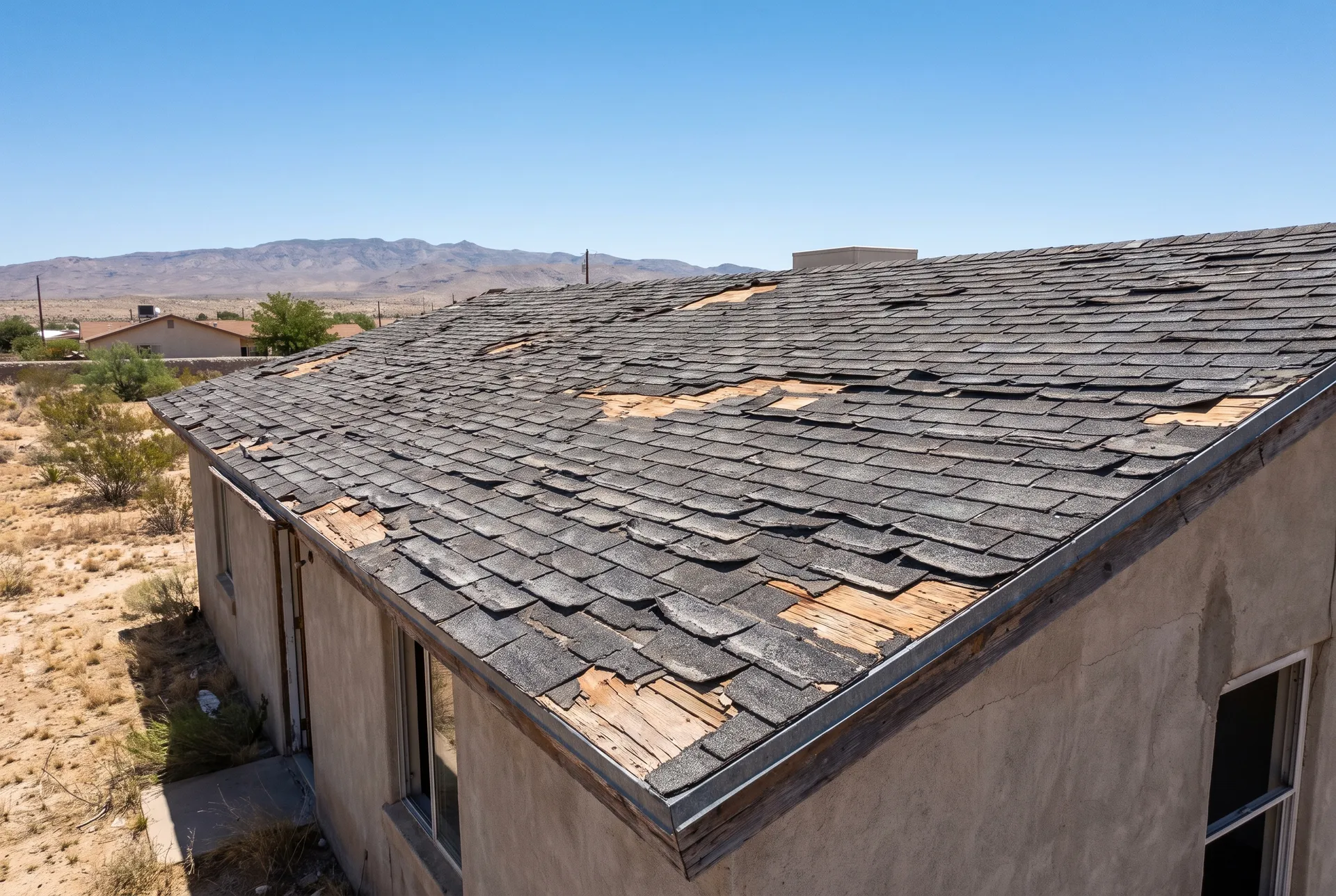
Why the stain is in the wrong place
Water gets through the roof surface, lands on the decking (the wood layer the roof covering is fastened to), and then travels. It follows the slope of the deck, runs along a rafter, soaks into insulation, and finally finds a seam in the ceiling drywall where it can come through. The exit point can be many feet from the entry point, and it is often not even in the same room.
This is why patching the ceiling accomplishes nothing and why sealing the roof directly above the stain fails so often. If the entry point was not found, the leak was not fixed. You will meet it again in the next storm, having paid for the privilege.
It is also why the size of the stain tells you very little about the size of the hole. A tiny gap at a flashing joint that concentrates water off a whole slope can put more water into a house than a missing shingle out in the open field. Diagnosis is the job. The repair itself is often the easy part.
Where roof leaks actually start
Penetrations and transitions, nearly every time. The open field of a roof is the part specifically designed to shed water and it usually does its job. The joints are where the design depends on something having been installed correctly and having stayed sealed for years in this sun.
- Plumbing vent boots. The rubber collar around a vent pipe is the single most common leak source on El Paso roofs. It is a small piece of rubber in relentless UV, and it cracks.
- Chimney and wall flashing. Anywhere the roof meets a vertical surface, the seal depends on metal correctly layered into the roof and into the wall. Done wrong once, it leaks forever.
- Valleys. Where two roof planes meet, water from both is concentrated into one channel. Small defects there handle a lot of water.
- Skylight curbs. Skylights leak at the frame and the curb rather than through the glass, and the failure is usually the seal or the flashing detail.
- Swamp cooler curbs and roof equipment. Common on homes here, frequently resealed badly after service, and directly over living space.
- Ridge, rake and drip edge. Wind-driven monsoon rain gets under edges that are not detailed properly, and it moves uphill more readily than people expect.
- Flat roof seams and ponding. On low-slope sections, standing water on a seam will eventually find its way through. The fix is often drainage rather than sealant. See flat roof repair for more on these systems.
Roof leak detection: how we trace a leak to its source
Finding a leak is detective work with a fixed method. Guessing is what produces the repairs that do not hold, so we work through it in order rather than starting where the stain is.
- Start inside. We look at where the water is appearing, what shape the stain is, and whether it changes with wind direction or only in heavy rain. That narrows the search considerably.
- Get into the attic. Where accessible, the underside of the deck tells the truth. Water tracks, dark staining and damp insulation point uphill to the entry.
- Work upslope on the roof. Water only travels down, so the entry point is always above the interior evidence, never below it. We follow it up.
- Inspect every penetration in that path. Boots, flashing, valleys, curbs and any old repairs. Previous sealant is a strong clue that somebody else already suspected this spot and missed.
- Test if needed. On a stubborn leak, controlled water testing in sections isolates the exact entry rather than leaving it to opinion.
- Check the decking. Once found, we determine how far the damage under the surface extends, because that decides the actual scope.
You get shown what we found. If we cannot explain to you why the water was getting in at that point, we have not finished diagnosing it.
What a leak is doing while you wait
A ceiling stain is the last symptom, not the first. By the time drywall discolors, the material above it has usually been wet through several storms, and the damage is spread across more than the roof.
Wet decking loses strength and eventually delaminates, which turns a surface repair into a structural one. Wet insulation compresses and stops insulating, which in an El Paso summer means a hotter house and a harder-working air conditioner. Rafters and rafter tails that stay damp begin to rot, and that is framing work rather than roofing. In a wall cavity, water travels down into places nobody will see until something is opened up.
This is also the mechanical reason El Paso roofs leak differently than roofs in a wet climate. Heavy year-round UV, among the highest of any US metro per National Weather Service published climate data for El Paso, drives the flexibility out of asphalt and rubber over time rather than rotting them. The daily swing between a hot afternoon and a cool night then works every joint, thousands of times over a roof life, until a seal that was fine on installation day opens on its own. Between monsoon storms this climate bakes the wet material and then wets it again, and each cycle makes the opening a little larger. Waiting is not a neutral choice; it is a decision to buy a bigger job later. We wrote this out at more length in why monsoon season finds every weak spot on an El Paso roof.
Quick seal versus a diagnosed repair
Most leak calls involve a choice between two very different products, and homeowners are not always told which one they are buying. Here is the honest comparison.
| Sealant over the stain | Traced and diagnosed repair | |
|---|---|---|
| What gets fixed | The spot on the roof directly above the interior evidence | The actual entry point, which is usually elsewhere on the roof |
| How long it holds | Often one season, sometimes less through a monsoon cycle | Meant to last for the service life of the surrounding roof material |
| What it costs upfront | Lower, since no time is spent tracing the path of the water | Higher, because diagnosis (inside, attic, upslope, penetrations) takes real time |
| What it costs over 3 years | Often higher once the same leak reappears and gets billed again | Lower in most cases, since the repair only happens once |
| What you get in writing | Usually nothing beyond a verbal description | Photographs of the entry point and an itemized written estimate |
We do the second one. If a quick seal is genuinely the right call for your situation, for example a rental you are about to sell, we will say so plainly rather than pretending there is only one right answer.
What to do the moment you find a leak
The goal in the first hour is to limit interior damage, not to fix the roof. Stay off the roof, especially in a storm, and especially in the heat.
- Move things out from under it. Furniture, electronics and anything absorbent. Then put a container down and something under the container.
- Relieve a bulging ceiling. A ceiling holding trapped water will eventually let go all at once. A small hole at the low point drains it in a controlled way and does far less damage than the collapse.
- Cut power to affected fixtures. If water is anywhere near a light or a ceiling fan, switch that circuit off at the breaker.
- Photograph everything. Date-stamped pictures of the stain, the drip and any damaged belongings. If a storm caused it and this becomes a claim, you will want them. Our storm and hail damage page covers that side.
- Note the conditions. Whether it leaks only in heavy rain, only with wind from one direction, or every time. That detail genuinely speeds up diagnosis.
- Call. We answer around the clock, which matters because leaks announce themselves at two in the morning during a storm. For a leak that is not pouring in, you can also request a free estimate online.
Repairing what the water damaged
Stopping the leak is half of it. The other half is the material the water passed through on its way in, and this is where a lot of leak repairs quietly stop short.
On the roof, decking that has been repeatedly wet gets replaced rather than covered, because soft sheathing will not hold fasteners properly and the new surface over it is compromised from day one. Rotted rafter tails or fascia get cut back to sound wood and rebuilt. Wet insulation gets removed, since compressed and soaked insulation is doing nothing except holding moisture against the structure.
Inside, there is drywall, texture, paint and sometimes trim. Because we do carpentry and framing and remodel work as well as roofing, that interior repair can be part of the same conversation and the same crew instead of a second contractor you have to find, schedule and coordinate. For most homeowners that is the practical difference between a job that ends and one that drags.
Why a previous leak repair failed
A large share of the leak calls we get are second attempts. The homeowner already paid somebody, the leak came back, and now there is understandable suspicion about the whole trade. The reasons are usually one of a short list.
- Sealant over the stain. Somebody applied roofing cement to the roof directly above the interior evidence, which is almost never where the water entered.
- The wrong penetration. Two boots ten feet apart, and the sound one got replaced.
- Surface fix over a flashing problem. Flashing has to be layered into the roof and the wall correctly. Caulking the outside of a bad flashing detail buys one season.
- Wet decking left in place. New material fastened into soft sheathing does not hold, so the repair loosens.
- More than one leak. The original leak was genuinely fixed and a second one was present the whole time. It happens, and it is why we inspect the whole roof rather than just the reported area.
- Drainage never addressed. On a flat roof especially, if water keeps ponding on a seam, patching the seam is a schedule, not a solution.
If someone has already been out, tell us what they did and where. Old sealant is a useful clue rather than an embarrassment.
When a leak means the roof is finished
Not every leak is a repair, and we would rather say so before you spend money than after. The question is not how bad this leak is; it is what the rest of the roof looks like.
If the leak is at a single penetration and the surrounding shingles are still flexible with their granules intact, repair is clearly the right call and it should last. If we find leaks in several unrelated places, or the surface is curling and shedding across whole slopes, or the decking is soft in more than one area, then repairs are a subscription. Each fix holds and the next weak point opens somewhere else, and after two or three rounds you have spent replacement money on a roof you still do not trust.
There is a code consideration as well. Once repairs pass roughly a quarter of a roof section inside a twelve month period, the whole section generally has to be brought up to current code rather than restored as it was, which changes the economics. Confirm how that applies to your address with the City of El Paso. When the numbers point that way, a full replacement is the honest recommendation, and we will show you the photographs that led us there.
Preventing the next leak
Most leaks in this city are preventable, and the prevention is seasonal rather than constant. None of the items below take long or cost much.
- Replace pipe boots before they fail. They are the number one leak source here, they are cheap, and the failure is visible during any inspection.
- Clear drainage before June. Wind-blown dust and grit clog gutters and flat-roof drains in this climate, and clogged drainage during a monsoon storm is how ponding starts.
- Look at the ceilings after storms. A faint ring caught early is a small repair. The same leak found next spring has been soaking the structure all winter.
- Check the attic twice a year. A flashlight and five minutes. Daylight, streaking or damp insulation all show up there long before drywall stains.
- Reseal after anyone works on the roof. Swamp cooler service, satellite installs and solar mounts all put holes in a roof. Check that whoever made them sealed them properly.
- Get an annual inspection. Once a year plus after any hail is sensible here, and ours is free with no obligation.
Related services
Frequently asked questions
There is a stain on my ceiling but no active drip. Is it urgent?
It is worth looking at soon. A stain means water has been getting in, and the decking and insulation above it have been wet even if nothing is dripping today. Leaks do not heal on their own; between monsoon storms this climate bakes the wet material and then wets it again, and each cycle makes the opening larger. The stain is the last symptom to appear, not the first sign of a problem.
Can you find a leak that other roofers could not?
Often, yes, because the usual reason a leak repair fails is that somebody sealed the roof above the interior stain rather than tracing where the water was really entering. Water travels along the deck and rafters before it exits, so the entry point is always uphill of the evidence and frequently in a different room. We start inside, work into the attic, then move upslope, and we water test when a leak refuses to reveal itself.
Do you fix the ceiling damage too?
Yes. We handle the roof and the structure the water damaged, including decking, rafter tails, fascia and wet insulation, and we do interior repair as well. Because we do carpentry, framing and remodel work alongside roofing, drywall and trim can be part of the same job rather than a second contractor you have to find and schedule. That is usually the difference between a repair that finishes and one that drags for weeks.
How much does roof leak repair cost in El Paso?
It depends on where the water is entering, how much decking underneath has been damaged, the roof material and pitch, and whether interior repair is part of it. Diagnosis is often the larger part of the work; the seal itself can be quick. What we can tell you is that the inspection and the written itemized estimate are free, and that any decking contingency is stated on the page rather than left open-ended.
Why does my roof only leak sometimes?
Because the entry point needs particular conditions to let water through. Wind-driven rain from one direction can push water under an edge that sheds a straight downpour without trouble. A partially blocked valley may only overflow in a hard monsoon cell. A cracked boot might only leak once material has been soaking long enough to saturate. That pattern is genuinely useful information, so tell us when it leaks and when it does not.
Can I use roof sealant as a temporary fix?
We would rather you did not, mainly because getting on a roof is dangerous and hot asphalt is slick and soft in an El Paso summer. There is a second reason too. Sealant smeared across a suspected area hides the evidence a roofer uses to trace the real entry point, so it can make the eventual proper repair harder and more expensive. Protect the inside of the house instead and let somebody get up there safely.
How fast can you get out for an active leak?
Tell us water is coming into the house when you call and we treat it as urgent, because active water damages decking, insulation and drywall for every hour it continues. We answer around the clock, which is deliberate, since leaks announce themselves during storms and at night rather than on a weekday morning. In a storm the first step is protecting the interior and stopping the water, with the permanent repair done on a dry roof.
Is a leak covered by insurance?
That depends entirely on your policy and on the cause, and it is a question for your carrier rather than for us. In general terms, sudden damage from a specific storm event is treated very differently from gradual wear or deferred maintenance. What we can do is document accurately what we found and when, with photographs, so the conversation with your carrier starts from facts. We will not tell you what your policy owes you.
Get a free estimate
Tell us what is going on and we will come look at it. Straight answer, written price, no pressure.