
Storm and hail damage roof repair in El Paso
After a hail or wind storm we come out, document what the storm actually did to your roof, and give you a written, photographed estimate you can hand to your insurance adjuster. Roofing Pros EPTX repairs storm damage across El Paso and the surrounding area. The inspection and the documentation are free, whether or not you end up filing a claim.
The first days after a storm run in this order: (1) note the date and rough time of the storm, since a claim is tied to a date of loss, (2) photograph what you can safely see from the ground, gutters, downspouts, vents, the AC unit, the fence, (3) get an independent roof inspection close to the storm date, before the insurance conversation starts, (4) report the loss to your carrier and let them schedule an adjuster, and (5) be there, or have us there, when the adjuster inspects the roof so both reports describe the same damage. What follows is usually one of three paths. Repair is right when the damage is confined to a few shingles or one section of flashing (the metal strips that seal the joints around chimneys, vents and walls). Replacement is right when hail bruising and wind lift show up across multiple slopes or the decking (the wood layer the roof covering is fastened to) underneath is already soft. Filing a claim only makes sense once you have your own documentation, since a carrier decides coverage from what is recorded, not from a guess. This page is not for you if you want a contractor to waive or absorb your deductible, since that is illegal in Texas and we do not do it, if you want someone to file or negotiate the claim on your behalf, since that is between you and your insurer, or if you are outside El Paso and the surrounding communities. The takeaway: document first, get the free inspection, then decide with your insurer whether a claim is worth filing.
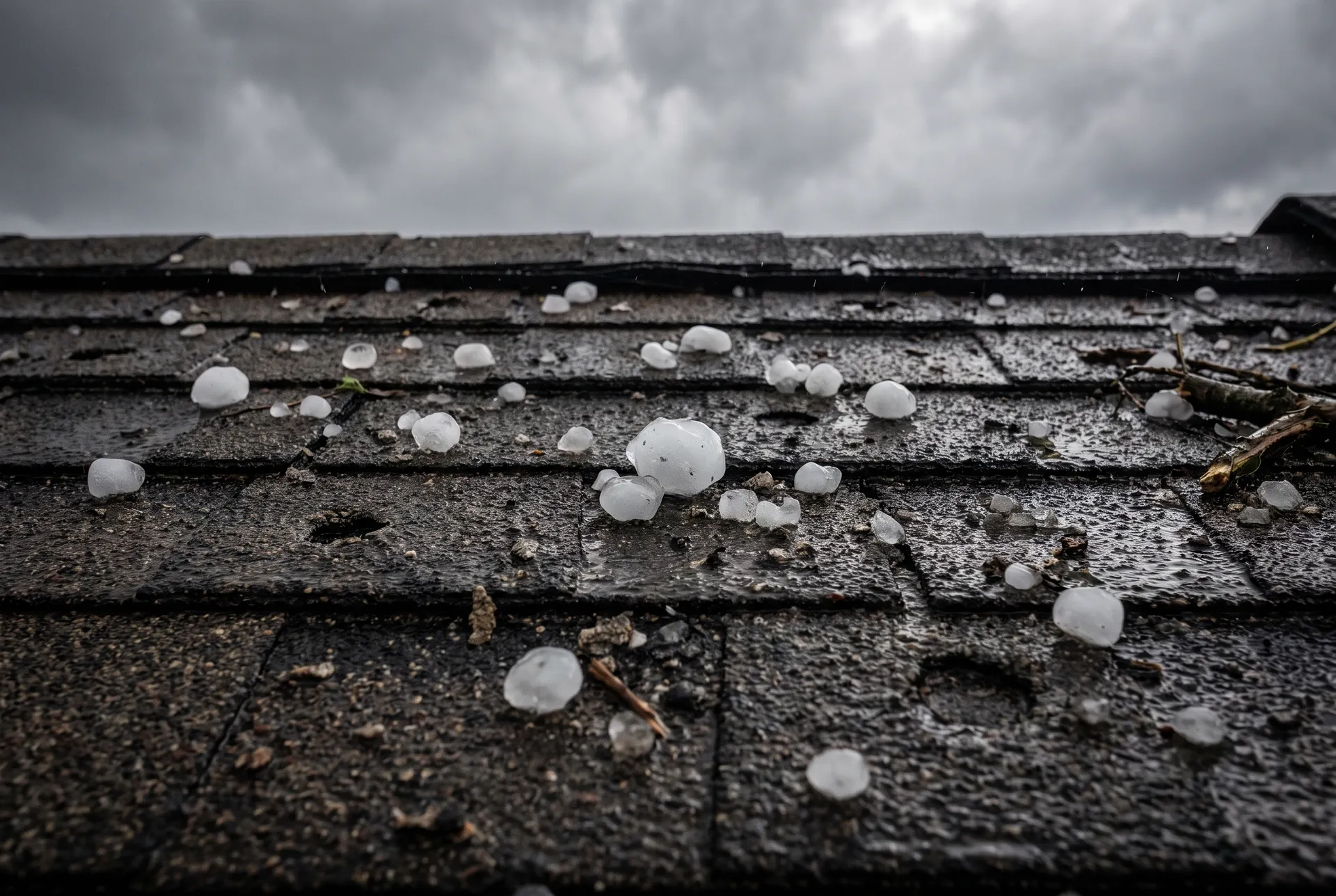
Hail damage does not always look like damage
Homeowners expect hail damage to look like a hole. Usually it does not. Hail bruises a shingle: the impact knocks the protective granules loose and fractures the mat underneath without breaking through, leaving a soft dark spot. From the ground, that roof looks completely normal.
What it has actually lost is time. A bruised shingle sitting under El Paso sun deteriorates far faster than the undamaged shingle beside it, because the granule layer that was shielding the asphalt is gone. That is why storm damage nobody found in July turns into leaks a year or two later, long after the storm is out of mind and the connection is hard to prove.
On other materials it reads differently. Hail cracks and chips concrete or clay tile, sometimes in a way only visible from directly above. It dents metal panels and, more importantly, can damage the finish, which is what protects the metal. On a flat membrane roof, hail can bruise or split the surface without opening it, and that spot becomes the seam failure a year later.
Wind damage after a monsoon cell
El Paso monsoon storms do not usually bring long steady wind. They bring downbursts: sudden, hard, short-lived gusts that hit from an unusual angle. That kind of wind does something specific to a shingle roof, and it is easy to miss.
It lifts and creases shingles without necessarily removing them. Every asphalt shingle has an adhesive strip that seals it to the one below; once wind breaks that seal and folds the shingle back, it will not lie flat and re-seal on its own. From the street the roof still looks like a roof. In the next storm, water and wind get underneath it.
The other wind targets are the parts that stand up: ridge caps, gable and rake edges, flashing, pipe boots, vents and swamp cooler housings. These take the force first and they are the parts most people never think to look at. A displaced ridge cap is a straight path into the attic.
What to do right after a storm
What you do in the couple of days after a storm has more effect on how this goes than almost anything later. None of it requires getting on the roof.
- Note the date. Write down the day and rough time of the storm. Claims are tied to a date of loss and memory blurs fast.
- Photograph from the ground. Take pictures of your yard, the debris, any dents on gutters, downspouts, vents, the AC unit, the fence and the car. Hail that dented a downspout hit the roof too.
- Check inside. Walk the top floor and look at ceilings and the tops of walls. Take a flashlight into the attic and look for daylight, damp insulation or fresh streaking.
- Protect the interior, not the roof. Move belongings, put down containers. Do not climb up there. A wet or hail-scoured roof is genuinely dangerous.
- Get a documented inspection. Have somebody who does this get on the roof and record what is there, close to the storm date. Ours is free and there is no obligation attached.
- Then decide about a claim. Documentation first, decision second. You can hold a written report and never file it, but you cannot file well without one.
If water is actively coming into the house rather than sitting as a stain, that changes what happens next. See emergency roof repair for what to expect in the first hour.
How the insurance claim process usually works
We are roofers, not your insurer and not a public adjuster, so nothing here is advice about your policy. This is just the shape of the process as it commonly runs, so it does not feel like a maze.
- You report the loss. You contact your carrier and give them the date of the storm and what you have observed.
- The carrier assigns an adjuster. A field adjuster is scheduled to come out and inspect the roof themselves.
- The inspection happens. It helps a great deal if your roofer is there for it, so the damage found is the same damage on both reports rather than two different documents.
- You receive a scope and estimate. The carrier issues its own itemized assessment of what it considers covered.
- Differences get reconciled. If the carrier scope misses items a roofer documented, those get raised with supporting photographs. This is normal and it is not a fight.
- Work is scheduled and completed. The repair or replacement is done to the agreed scope, and final documentation goes back to the carrier.
Two honest cautions. First, nobody can tell you in advance what your policy covers, including us; that lives in your deductible, your coverage type and your policy language. Second, be careful with anyone offering to cover, waive or absorb your deductible. Texas law bars a contractor from advertising, paying or rebating a homeowner insurance deductible as an inducement to buy roofing work; the Texas Department of Insurance publishes consumer guidance on this exact practice. So that offer is a legal problem, not a favor, and it should end the conversation.
Why storm chasers show up after El Paso hail
Every notable hail event in this region is followed by out-of-town crews working the neighborhoods door to door. Some are legitimate. Many are not, and the pattern is consistent enough to be worth naming.
- The unsolicited knock. They arrive days after a storm, often claiming they were already working a neighbor roof.
- A free roof. Language about insurance paying for everything, or an offer to handle your deductible. Treat both as an exit cue.
- Urgency. A price good only today, or a contract to sign on the spot before you have read it.
- Big deposit, no materials. Money up front well before anything is delivered to your property.
- No local footing. A cell number and a magnetic door sign, with no local address, no permit talk, and nothing to come back to.
- Damage that appears during the inspection. A crew that creates marks in order to find them is committing fraud, and you are the one holding the claim.
A roof installed by a company that leaves the state next month has nobody standing behind it. That is the whole risk, and it usually shows up years later. More on vetting a contractor on our roof replacement page.
When El Paso actually gets storm damage
NOAA and the National Weather Service define the North American monsoon as reaching this region roughly from mid-June through September, delivering a large share of the annual rainfall in a relatively small number of events. That concentration is the point. A roof here can sit dry and untested for most of the year and then take repeated hard hits inside a few weeks.
Those storms are the ones carrying hail and downburst wind. Most of our storm calls come during that stretch and in the weeks afterward, once a homeowner has finally seen a stain or found shingle pieces in the yard. Damage from a July storm regularly gets reported in September.
Winter is quieter but not harmless. Freezing overnight temperatures with mild afternoons mean water that got into a hail crack or a split boot expands and contracts every night, widening the opening a little at a time. That is why an autumn inspection is worth doing on a roof that took a summer storm, before the freeze cycle spends the whole winter working on it.
What our storm inspection actually covers
A real storm inspection is not a walk around the yard. It is a systematic look at every part of the roof that a storm damages, documented so it means something to somebody who was not there.
- The roof field, slope by slope. Hail hits directionally, so damage is usually worse on the slopes facing the storm. We check each one rather than generalizing from the easiest to reach.
- Bruise density. Whether impacts are scattered or concentrated matters, and it is recorded rather than described from memory.
- Seals and creasing. Checking whether shingles have been lifted and broken free of their adhesive strip, which is the wind damage nobody sees from the ground.
- Flashing, valleys and ridge. The joints and edges that take wind first.
- Penetrations. Vents, pipe boots, skylights, satellite mounts and swamp cooler curbs, all of which are hail-soft and wind-exposed.
- Soft metals. Gutters, downspouts, drip edge, AC fins and vent caps. Dents in soft metal are a strong indicator of what the roof took.
- The attic and interior. Because what water has already done inside is part of the picture.
You get the photographs and a written scope. That report belongs to you, whether you hire us, hire somebody else, or do nothing at all.
Repair or replace after a storm
Storm damage does not automatically mean a new roof, and we are not going to pretend it does. Isolated damage on a roof in good condition is a repair, and treating it as a repair is the correct answer even when a replacement would be a bigger sale for us.
What pushes it toward replacement is spread. Bruising across every slope means the whole surface has lost service life at once, and patching a hundred individual impacts is neither practical nor durable. Widespread creasing has the same effect, because a shingle that will not re-seal is a future leak whether or not it looks damaged today.
The code angle matters too. Once repairs exceed roughly a quarter of a roof section within a twelve month period, the requirement to bring the whole section up to current code is generally triggered, which changes the economics sharply. That is a jurisdiction question, so confirm it with the City of El Paso rather than taking anyone word for it. When a storm has genuinely spread damage across the roof, full replacement is usually both the honest answer and the cheaper one over time.
The damage a storm does that is not the roof
Wind and hail do not confine themselves to shingles, and a report that only covers the roof surface misses things that will cost you later.
Fascia and soffit take wind hard, particularly at gable ends and corners. Once fascia is loose or split, water reaches the ends of the rafters, and rotted rafter tails are a framing repair rather than a roofing one. Gutters get torn loose or bent so they no longer carry water away from the house, which quietly turns a roof problem into a foundation and stucco problem.
Detached structures matter too: carports, patio covers, sheds and fences. Because we do carpentry and framing as well as roofing, the wood damage under and around a storm-hit roof gets handled by the same crew rather than stalling the job while a second contractor is found. That is the practical reason those two trades sit together here.
Getting ready for the next monsoon season
You cannot stop hail. You can put the roof in a state where a storm does less to it, and every item below is cheap compared to what it prevents.
- Have the roof looked at in spring. Before June, not after the first storm. A defect found in April is a small repair; the same defect in August is an interior water event.
- Clear all drainage. Gutters, scuppers and flat-roof drains fill with wind-blown dust here, which is exactly what makes water pond during a downpour.
- Reseat anything loose. Lifted shingles, loose ridge cap and worn pipe boots are what the wind grabs first.
- Trim back branches. Limbs over a roof abrade it in wind and become projectiles in a downburst.
- Secure roof equipment. Swamp cooler housings, satellite mounts and vent caps all come loose over time and all leak once they do.
- Photograph the roof while it is fine. A dated set of clear before photographs is the single most useful thing a homeowner can have when a claim is questioned later.
Related services
Frequently asked questions
Should I get my roof looked at after a hail storm even if it looks fine?
Yes, and this is the most common expensive mistake we see. Hail bruising is frequently invisible from the ground because it removes granules and fractures the mat without punching through. The roof looks normal and has still lost years of service life. Getting the damage documented close to the storm date is also far easier than establishing it two years later, when it can be dismissed as ordinary age. The inspection is free either way.
Do you work with insurance claims?
We document the damage thoroughly with photographs and give you a written, itemized scope you can hand to your adjuster, and we can be there when the adjuster inspects so both reports describe the same roof. What we do not do is handle the claim, interpret your policy, or promise you an outcome, because we are roofers rather than public adjusters. Anyone guaranteeing you a claim result is telling you something they cannot know.
When is storm season in El Paso?
The monsoon reaches this region in summer, generally from around June into September, and it brings a large share of the annual rainfall along with the hail and downburst wind. Most storm damage calls arrive during that stretch and in the weeks after it. Winter matters in a different way: freezing nights and mild afternoons work on any crack a summer storm opened, widening it a little at a time.
What does the storm inspection cost?
Nothing. The inspection and the written documentation are free whether or not you file a claim and whether or not you hire us. You keep the photographs and the report and can take them anywhere. We think a company that charges to look at a storm-damaged roof has the incentives pointed the wrong way, and we would rather be the crew you remember calling next time.
How do I know if a roofing company is a storm chaser?
The pattern is consistent: an unsolicited door knock in the days after a storm, talk of a free roof or help with your deductible, a price that expires today, a large deposit before any material arrives, and no local address to go to. Ask where their office is, whether the permit is in the bid, and who the crew works for. Then take a day. No legitimate roofer objects to you thinking about it overnight.
Can hail damage cause a leak right away?
Sometimes, but usually not, and that is what makes it dangerous. Large hail can crack tile or split a membrane and leak the same night. The far more common case is bruising that removes granules and fractures the shingle mat without opening it, so nothing leaks for a year or more while that spot ages several times faster than the roof around it. By the time water shows up inside, the storm is old news.
My roof is old. Does storm damage still matter?
It matters for the roof either way, since damage on an aging roof accelerates a surface that was already close to the end. Whether it matters for a claim depends entirely on your policy and how your carrier treats depreciation and age, which is a question for them and not for us. What we can do is document accurately what the storm did as distinct from ordinary wear, and be straight with you about which is which.
How soon after a storm should I call?
Within the first week if you can. Two things get harder with time. Documentation loses its clear link to a specific date of loss, and a small opening left through the rest of monsoon season takes several more storms while the sun works on the wet material in between. Getting a roof recorded quickly costs you an hour and preserves every option you have afterward.
Get a free estimate
Tell us what is going on and we will come look at it. Straight answer, written price, no pressure.