
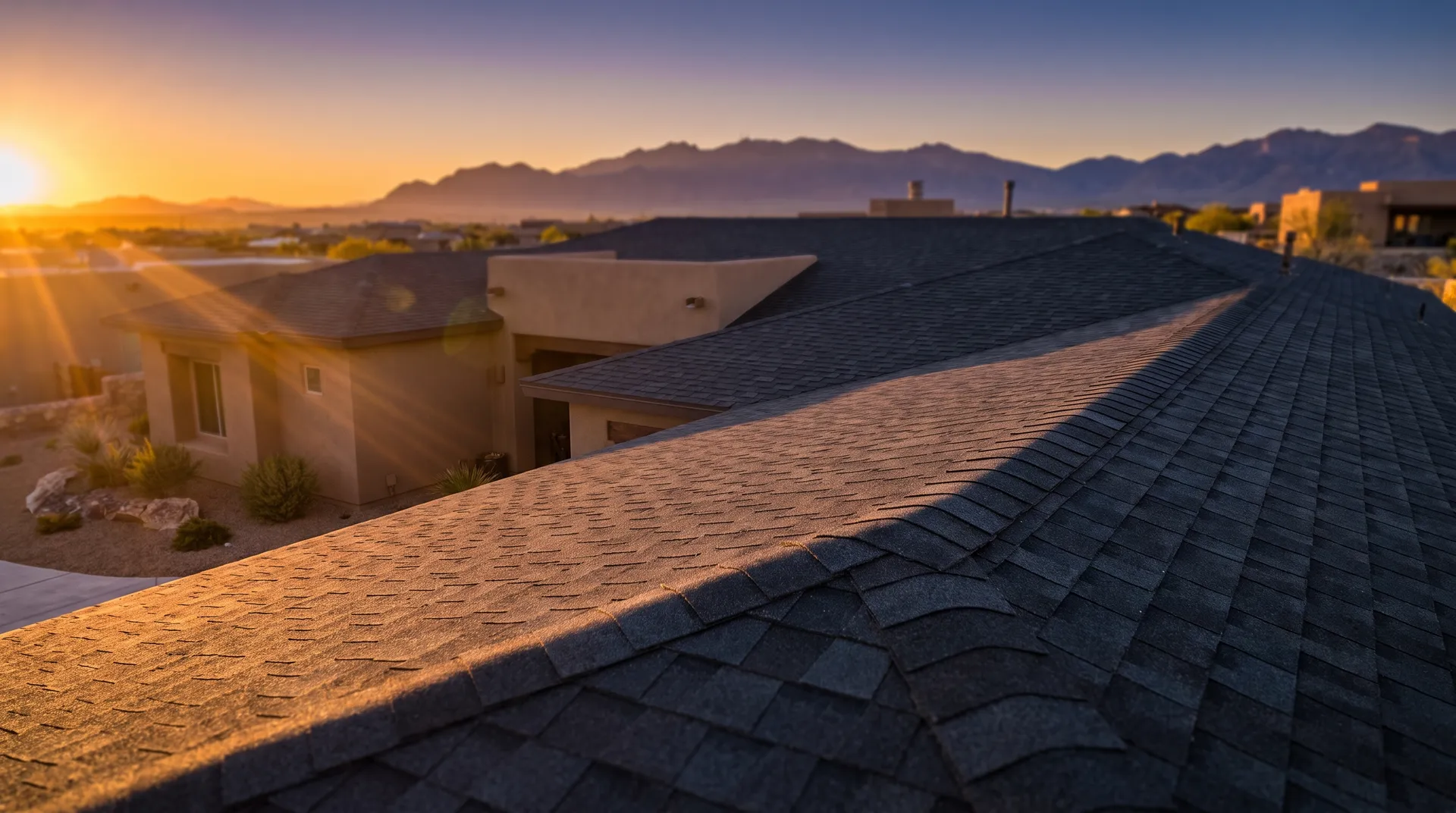
If you are choosing a roof covering in El Paso, the climate decides more of that choice than style does. This city stacks four things onto one roof in a single year: sun and UV on most days of the year, summer surface temperatures well above the air temperature, a monsoon season that dumps a large share of the annual rain into a handful of storms, and hail riding along with those same storms. A material that performs well in a mild, cloudy climate can be the wrong pick here, and a material with a reputation for being expensive or old-fashioned can be exactly right for this specific set of conditions.
This guide compares the roofing materials actually used on El Paso homes and small commercial buildings: three-tab and architectural asphalt shingles, clay and concrete tile, metal, and the flat and low-slope systems common on this city’s older neighborhoods. It also covers how hail-impact ratings work and what a cool roof is, so you can read a bid or a product label and know what it actually means for a roof in this climate.
Three-Tab vs. Architectural Asphalt Shingles: What’s the Difference?
Asphalt shingles are the most common residential roofing material in El Paso by a wide margin, and there are two basic grades on the market.
Three-tab shingles are a single flat layer, cut into uniform tabs, and they were the standard residential shingle for decades. They are the lighter, thinner, and less expensive of the two.
Architectural shingles, also called dimensional shingles, are built from two or more layers laminated together, which gives them a thicker, textured look and more mass per square foot. That extra mass and layering generally makes them more wind-resistant and more durable against the surface stress that comes from El Paso’s daily heat cycling, which is one reason they have become the more common choice for shingle roof replacement across this city over the last several years.
Both are still asphalt, and asphalt is the material that El Paso’s UV works hardest against. Ventilation and underlayment quality matter more on an asphalt roof in this climate than the shingle grade alone, because the sun is attacking the material every sunny day of the year, not just during storms. See our roof replacement page for how we scope a full tear-off (removing the old roofing down to the wood before the new roof goes on) and reroof, and roof repair for targeted shingle repairs and matching.
Clay Tile vs. Concrete Tile: Which Holds Up Better in This Climate?
Tile is common on stucco and Southwest-styled homes across El Paso, and it is worth understanding one fact before comparing clay to concrete: the tile itself is not the waterproofing. Tile is a rain screen and a UV shield. The actual waterproofing layer is the underlayment installed beneath the tile, against the deck, which means a tile roof depends on two materials aging well together, not one.
Clay tile is fired earth, and it holds its color permanently because the color is part of the material itself rather than a surface coating. It handles direct UV about as well as any roofing material available, which is a real advantage in a city with this much sun exposure. Clay is also more brittle than concrete, so it is more prone to cracking under a hard impact or careless foot traffic.
Concrete tile is molded and typically finished with a surface coating or an integral color mix. It is generally less brittle and somewhat more impact-tolerant than clay, though a heavily worn concrete tile’s surface finish can fade or wear over a long service life in strong sun, which is a cosmetic issue rather than a waterproofing one as long as the tile itself is intact.
On both, the underlayment beneath the tile is the part that actually needs periodic attention, because heat cycling ages it under the tile field where it cannot be seen from the ground. See tile roof repair for how we inspect and repair cracked, slipped, or broken tile, and how we check the underlayment (the water-resistant layer under the shingles or tile) underneath it rather than assuming intact tile means a dry roof.
Metal Roofing in El Paso: Worth the Cost?
Metal roofing, including standing seam panels, works on a different principle than shingle or tile. Instead of absorbing heat the way asphalt does, a metal roof reflects a meaningful share of solar radiation away from the building, which is a genuine advantage in a climate this sunny.
Metal also sheds monsoon rain fast and handles wind well once it is properly fastened. What it demands in return is correct detailing at every seam and penetration, because metal expands and contracts with daily temperature swings more than any other common roofing material, and that movement is exactly where a poorly detailed metal roof eventually leaks. Fasteners, not the panels themselves, are the usual failure point on an aging metal roof.
Metal carries a higher material and installation cost than asphalt shingles. Whether that cost is worth it depends on how long you plan to be in the house, your tolerance for the visual difference from a shingle roof, and how you weigh the reflectivity advantage described above. It is not a universal upgrade, but it is a legitimate one for this climate.
Flat and Low-Slope Roof Systems: Mod Bit, TPO, Foam, and Coatings
A large share of El Paso homes and small commercial buildings have flat or low-slope roof sections, and these systems fail in their own particular ways because water sits on them rather than running off quickly the way it does on a pitched roof.
- Built-up roofing (BUR). Layers of asphalt and reinforcing felt, often finished with a gravel surface. Common on older buildings. It ages through blistering, cracking, and seam separation from years of UV and heat cycling.
- Modified bitumen. A newer evolution of the same asphalt-based approach, applied in fewer, thicker sheets and heat- or torch-welded at the seams. Seam integrity is the main long-term concern.
- TPO and other single-ply membranes. A single sheet of membrane, generally heat-welded at the seams and mechanically or adhesively attached to the deck. TPO is reflective by design, which helps with the same heat-load problem metal addresses. Punctures and seam failure are the usual issues.
- Foam roofing (SPF). Sprayed polyurethane foam applied over the existing deck or roof, finished with a protective coating. The coating is the wear layer; once it thins or cracks, the foam beneath it can take on water.
- Elastomeric and acrylic coatings. Applied over an existing membrane or foam roof to extend its service life and add reflectivity. A coating that has chalked, cracked, or worn thin needs recoating before the layer underneath starts taking direct sun and water.
Across every flat system, the single most common cause of a repeat leak is ponding water finding a weak seam or a cracked coating, not a sudden hole. See flat roof repair for how we diagnose and repair each of these systems.
How Roofing Materials Compare
| Material | UV/heat performance | Hail behavior | Typical failure point | Best suited for |
|---|---|---|---|---|
| Three-tab asphalt shingle | Adequate; thinnest asphalt option, ages faster under constant sun | Can bruise or crack under moderate-to-large hail | Granule loss, curling, sealed-strip failure | Budget-conscious pitched roofs |
| Architectural asphalt shingle | Better than three-tab; extra mass resists heat-cycling stress | More impact-resistant than three-tab, still asphalt | Same failure modes as three-tab, generally slower to appear | Most El Paso pitched residential roofs |
| Clay tile | Excellent; color is permanent, handles direct sun very well | Brittle; can crack or chip under hard impact | Cracked/slipped tile, and underlayment aging unseen beneath it | Southwest and stucco-style homes |
| Concrete tile | Very good; generally more impact-tolerant than clay | More impact-tolerant than clay tile | Same underlayment concern as clay, plus surface finish wear over time | Southwest and stucco-style homes |
| Metal / standing seam | Excellent; reflects rather than absorbs heat | Can dent; finish damage is the real concern, not structural failure | Fastener and seam movement from thermal cycling | Owners prioritizing heat reflectivity and longevity |
| Modified bitumen / BUR | Adequate; ages with heat-cycling and UV over years | Can bruise or split without immediately opening | Seam separation, blistering, cracking | Flat and low-slope residential/small commercial |
| TPO membrane | Good; reflective surface reduces heat load | Can puncture or bruise at seams | Seam failure, punctures | Flat and low-slope roofs prioritizing reflectivity |
| Foam (SPF) with coating | Good, dependent on coating condition | Coating can bruise or crack under impact | Coating breakdown exposing foam to water | Flat roofs needing a seamless, insulating system |
Exact lifespan in years is not printed here on purpose. Service life depends on installation quality, ventilation, maintenance history, and this climate’s specific stresses, and any number given without inspecting the actual roof is a marketing figure rather than a fact about your house. What the table above reflects is the qualitative pattern: heavier, UV-stable materials like tile and metal generally outlast lighter asphalt materials in this climate, while flat systems depend heavily on maintenance and drainage rather than on the base material alone.
What Does a UL 2218 Hail Rating Actually Mean?
UL 2218 is a real, independently administered impact-resistance test standard, published by UL (formerly Underwriters Laboratories), that roofing manufacturers use to rate how a roof covering material holds up against simulated hail impact. It is the standard most insurance discussions of “impact-resistant” roofing refer to.
The test drops steel balls of specified sizes onto roofing samples from set heights to simulate hail strikes, then examines the underside for fracturing. Materials are rated Class 1 through Class 4, with Class 4 representing the highest level of impact resistance tested under the standard.
A Class 4 rating does not mean a roof is hail-proof. It means the specific product tested performed to the highest tier this particular standard measures, under laboratory conditions. Real hail events vary in size, angle, and velocity, and installation quality affects real-world performance in ways a lab test cannot fully capture. If your insurance policy offers a discount for impact-resistant roofing, ask your carrier which class and which documentation they require, since that is a policy question rather than a roofing one. We can tell you what rating a given product carries when you are comparing materials; we cannot tell you what your specific policy pays for it.
What Is a Cool Roof, and Does It Make Sense in El Paso?
A cool roof is a roof surface designed or coated to reflect more sunlight and absorb less heat than a standard dark roof surface. On a flat roof, that generally means a reflective membrane like TPO or a white or reflective elastomeric coating over an existing system. On a pitched roof, certain shingle products and most metal roofing offer meaningfully more reflectivity than a standard dark asphalt shingle.
The appeal in this climate is straightforward: a cooler roof surface can lower the heat load transferring into the attic, which is relevant to cooling costs during the months when El Paso air conditioning runs hardest. Whether it is worth pursuing depends on your roof type, your existing system’s condition, and your priorities, and it is a reasonable question to raise during a roof replacement or a flat roof recoat.
How to Choose the Right Roofing Material for Your House
Picking a material is a short, sequential decision once you know your roof’s shape and your own priorities.
- Identify your roof’s shape. A pitched roof (shingle, tile, or metal) and a flat or low-slope section (mod bit, TPO, foam, or coatings) are different decisions, and many El Paso homes have both on the same structure.
- Set your budget range. Asphalt shingles sit at the lower end of material cost, tile and metal sit higher, and flat systems vary by which membrane or coating is specified.
- Weigh heat reflectivity against upfront cost. If reducing summer heat load matters more to you than minimizing sticker price, that points toward metal, tile, or a reflective flat membrane over a standard dark asphalt shingle.
- Check what is already on the roof. A repair or a recoat on an existing system is often the right call before a full material change is worth considering; see the material sections above for what each system’s failure points actually look like.
- Get the roof measured and inspected. A free inspection tells you the roof’s actual condition, its pitch and complexity, and what a written estimate looks like for the materials that fit your house, rather than guessing from a listing of square footage.
Frequently Asked Questions
What is the best roofing material for El Paso heat? There is no single answer, because it depends on your budget, your roof’s pitch, and how much you weigh reflectivity against upfront cost. In general, tile and metal handle direct UV and heat cycling the best of the common options, architectural asphalt shingles are a reasonable middle ground, and any flat system benefits from a reflective membrane or coating regardless of which base material is underneath it.
Are architectural shingles worth it over three-tab for a shingle roof replacement? For most El Paso homes, yes. The extra layering gives architectural shingles more mass and generally better wind and impact performance than three-tab, and that difference matters more in a climate that stresses shingles daily with heat cycling. The trade-off is a higher material cost, which is worth weighing against your specific budget and how long you plan to stay in the house.
Does hail damage affect all roofing materials the same way? No. Hail bruises asphalt shingles, often invisibly, by knocking loose the granules and fracturing the mat underneath without breaking through. It cracks or chips brittle materials like clay tile. It dents metal and can damage a metal roof’s protective finish. On flat membrane or foam roofs, hail can bruise or split the surface without immediately opening it. The visible damage differs by material, which is one reason a professional inspection after a hail event matters regardless of what your roof is made of.
What roofing material lasts longest in El Paso? As a general pattern, heavier and more UV-stable materials such as tile and metal tend to outlast lighter asphalt shingle roofs in this climate, and flat systems depend heavily on maintenance and drainage rather than on the base material alone. Actual service life on any specific roof depends on installation quality, ventilation, and maintenance history, which is why we avoid printing a specific year figure without having inspected the roof in question.
Is a metal roof worth the extra cost in El Paso? It can be, depending on your priorities. Metal reflects heat rather than absorbing it, sheds monsoon rain quickly, and handles wind well when properly installed and detailed. The trade-off is a higher upfront cost than asphalt shingles and installation that depends on correct detailing at every seam and penetration. It is a legitimate upgrade for this climate, not a universal one.
What is the difference between a repair and a full shingle roof replacement? A repair addresses damage confined to one or two areas on a roof that is otherwise sound. A replacement is the right call when granule loss, curling, or leaks show up across multiple areas of the roof, or when the decking (the wood layer the roof covering is fastened to) underneath has gone soft. A free inspection is the fastest way to know which situation you are actually in. See our roof replacement and roof repair pages for how each process works.
If you are weighing materials for a new roof or a shingle roof replacement anywhere in El Paso or the surrounding communities, including Socorro, Roofing Pros EPTX will walk your specific roof and tell you plainly what makes sense for it, not just what is popular. The inspection and the written estimate are both free. Call (915) 222-2924 or request a free estimate.