
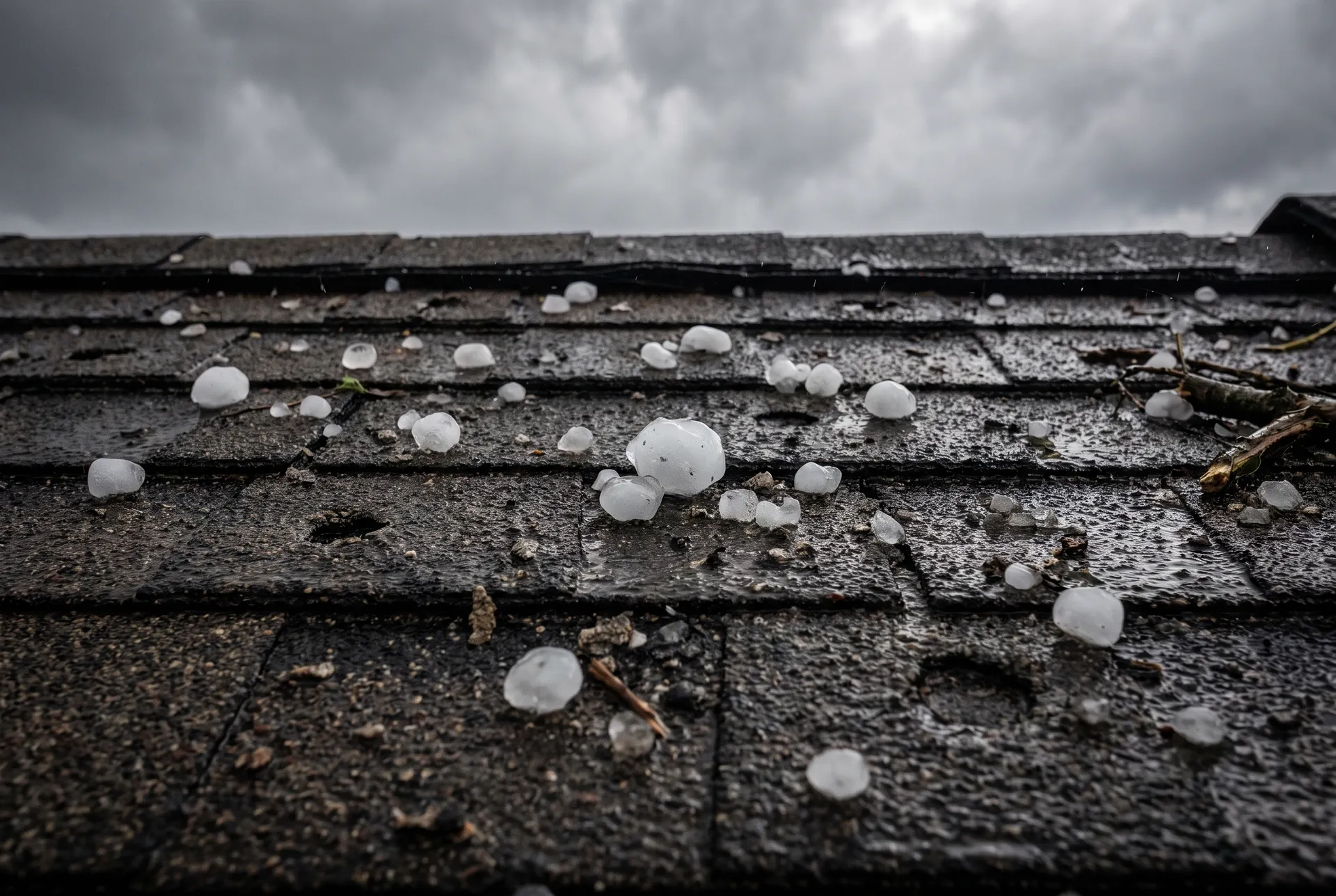
If a hailstorm just came through your neighborhood, do this first: get down safely, do not climb on the roof yet, and take photos of anything you can see from the ground, including your yard, gutters, AC unit, and vehicles. Then get an independent roof inspection before you call your insurance company, so you have your own documentation before an adjuster ever shows up.
That order matters more than most homeowners realize. A lot of people call their insurance company the same afternoon a storm hits, before anyone has actually looked at the roof. That is not wrong, exactly, but it means the first person to describe the damage to the insurance company is you, not someone trained to see it. Here is how to handle it the right way.
How Do I Know If My Roof Has Hail Damage?
From the ground, look for granules from your shingles collecting in gutters or downspouts, dented gutters or downspouts, dings on your AC unit or window screens, and dark or bruised-looking spots on the shingles you can see from a safe distance. Dented soft metal (vents, flashing, gutters) is one of the more reliable signs, because it shows the size and force of the hail even if the shingles themselves look okay from far away.
Hail damage does not always look dramatic. Sometimes it is a bruise that breaks the shingle’s waterproofing without tearing it open, and you would not know it is a problem until it starts leaking weeks or months later. That is exactly why a proper inspection matters more than eyeballing it from the driveway.
What Should I Do Right After a Hailstorm?
- Stay off the roof. Wet or bruised shingles are more likely to crack under foot traffic right after a storm.
- Photograph what you can see from the ground: the roof, gutters, siding, AC unit, fencing, and any hail on the ground (a coin or ruler next to a hailstone in the photo gives you a size reference).
- Cover any obvious holes or exposed areas with a tarp if it’s safe to do so, and keep receipts for tarps or emergency materials. Insurance typically reimburses reasonable costs to prevent further damage.
- Get an inspection from a roofer before you file, or right after you file, so you have a second set of eyes documenting the damage in writing.
- Do not authorize any permanent roof repairs until the adjuster has inspected the roof, unless it is a safety issue.
Should I Call My Insurance Company or a Roofer First?
Either order works, but get a roofer’s documentation into the process early. Under Texas law, a roofer cannot file the claim for you or negotiate directly with your insurance company on your behalf, that part is between you and your insurer. What a roofer can do is inspect the roof, document what they find with photos, and be present when the adjuster comes out.
Having your roofer there for the adjuster’s visit is one of the most useful things you can do. Two sets of trained eyes on the same roof, comparing notes on the spot, tends to produce a more complete and accurate scope of damage than an adjuster working alone, especially on damage that is easy to miss like bruised shingles or compromised flashing.
How Long Do I Have to File a Hail Damage Claim in Texas?
How long you have to report the damage is set by your own policy, not by a single statewide deadline. Most Texas homeowners policies require prompt notice of a loss, and some carriers have tightened that language to a fixed number of days or months after the storm, so read the notice of loss section of your policy or ask your agent for the exact window. Whatever it says, do not wait. The sooner you file, the easier it is to tie the damage to a specific, verifiable storm date, and the less chance there is that a second storm before your claim gets filed muddies which damage came from which event.
If your damage involves actual flooding rather than wind-driven rain or hail, that falls under separate flood insurance rules with a much shorter filing window, so do not assume the notice window in your homeowners policy covers every kind of storm damage.
What Happens When the Insurance Adjuster Comes Out?
The adjuster will inspect the roof (and often the rest of the exterior) and write up their own estimate of the damage and repair cost. This is where having your own documentation, and ideally your roofer present, pays off. If the adjuster misses damage that is hard to spot, like a bruised shingle mat or displaced flashing, your roofer can point it out on the spot rather than you trying to argue about it over the phone later.
What If the Insurance Offer Seems Too Low?
Compare the adjuster’s written estimate against your roofer’s assessment, item by item. If there is a real gap, in Texas you can request a re-inspection, and most policies include appraisal rights if you and the insurer genuinely cannot agree on the value of the damage. This is not usually the first move, most claims settle fairly, but it is worth knowing the option exists before you sign off on a number that does not match what a roofer actually found on your roof.
What to Photograph, Item by Item
Photographs are the cheapest part of a claim and the part homeowners most often do badly. Work through this list from the ground the same day, and again the next morning in better light.
- A hailstone with something for scale. A quarter, a ruler, your hand. Size is one of the first things an insurer asks about, and memory is not evidence.
- The ground, before it melts. Hail on the lawn, the driveway, the patio furniture. This ties the damage to a specific event at a specific address.
- Gutters and downspouts. Dents in soft metal are the clearest proof of impact force, and they survive long after the hail is gone.
- Granules. Piles at the bottom of downspouts, in the gutter, on the driveway.
- The AC condenser and any swamp cooler. The fins dent easily and they are almost always missed.
- Window screens, garage door, mailbox, fence and vehicles. Collateral damage helps establish the storm’s severity.
- Every elevation of the house, shot straight on from a distance, plus close-ups of anything visible on the roof from the ground.
- Interior ceilings and the attic, if anything is wet or stained.
- Wide shots that include a landmark. One photo showing your house number or street sign anchors the whole set to your property.
Keep the originals on the phone rather than sending compressed copies. The file dates matter.
The Timeline of a Hail Claim, Start to Finish
Every claim runs differently, and the pace depends on how many houses in your area were hit the same day. The shape is usually this.
Day of the storm. Photograph from the ground. Tarp anything open if it is safe. Keep the receipts for emergency materials.
Within a few days. Get an independent roof inspection so you have your own written documentation, then file with your insurer. You will get a claim number and be assigned an adjuster.
One to three weeks. The adjuster inspects. Ask to have your roofer there for that visit. After a big storm this step can take longer, because every adjuster in the region is working the same neighborhoods.
Days after the inspection. You receive a written scope and an estimate from the insurer, along with the first payment, which on most policies is the actual cash value figure with your deductible and any depreciation held back.
Next. Your roofer reviews that scope against what they documented. If items are missing, this is when they get raised, in writing, with photographs. A supplement is a normal part of the process and not a fight.
Then the work. Materials get ordered, the job gets scheduled, the roof gets built. If your policy pays replacement cost, the held-back depreciation is released after the work is finished and invoiced.
Finally. Keep everything: the claim number, the adjuster’s scope, your roofer’s estimate, the invoice, and the before and after photographs. That folder is what you hand the next insurer or the next buyer.
How to Handle the Adjuster Visit
The adjuster is not your opponent. They are working from what they can see and document on the day, and your job is to make sure what is really there ends up in that document.
Be present, or have your roofer present, or both. Walk them to what you already found rather than waiting to see whether they spot it. Hand them your photographs at the start of the visit, not after they have written the report. Ask, politely and specifically, whether they marked the flashing, the vents and the soft metal as well as the shingle field.
Write down the adjuster’s name, the date, and what they said they were going to do. Ask when the written scope will arrive and how it will be sent. When it comes, read every line item and compare it against your roofer’s assessment before you sign or cash anything, because agreeing to a scope is easier than reopening one.
If something genuinely was missed, that is what a supplement is for. Photographs plus a written explanation from a roofer who was on the roof carry far more weight than a phone call disagreeing about it.
How to Spot a Storm Chaser
After a big hailstorm, out-of-town crews arrive in El Paso the same week and knock every door in the affected zip codes. Some are competent. Many are gone before your workmanship warranty means anything.
Warning signs worth taking seriously:
- An offer to waive, cover, discount or absorb your deductible. This is illegal in Texas under Insurance Code Chapter 707, and it tells you everything about the rest of the operation.
- Pressure to sign today, or a contract that assigns your claim benefits to them.
- No permanent local address, and a phone number that goes to a different area code.
- A free inspection that immediately finds severe damage without showing you a single photograph.
- Vague answers about the license and insurance documents when you ask to see current copies.
- A price that only makes sense because they are planning to lay new material over the old roof.
Ask any contractor, local or not, for current license and insurance paperwork, and ask who will still be answering the phone in five years. A local company that has to keep working in this city has a reason to answer that question honestly.
Reading Your Own Policy Before You Need It
Two lines in the policy decide most of what happens after a storm, and both are worth finding today rather than the week after a hailstorm.
The first is how your roof is covered. Replacement cost coverage pays what it takes to put an equivalent new roof on, usually in two payments with the depreciation released after the work is complete. Actual cash value coverage pays the depreciated value of an aging roof, which on an older roof can be substantially less than the cost of replacing it. Some Texas policies now apply an actual cash value schedule to the roof specifically, even when the rest of the house is covered at replacement cost.
The second is the deductible. Many policies here use a percentage of the insured value for wind and hail rather than a flat figure, and a percentage deductible on a house can be several thousand dollars. That number decides whether a claim is worth filing at all.
Neither of these is something a roofer can change, and any roofer who offers to work around them is offering to break the law. Read your declarations page, or call your agent and ask both questions directly.
Replacement Cost vs. Actual Cash Value: What Your Payout Actually Depends On
These are the two coverage types most El Paso homeowners policies use for roof claims, and the difference decides what check you actually get.
| Replacement cost coverage | Actual cash value coverage | |
|---|---|---|
| What it pays | The cost of an equivalent new roof | The depreciated value of your existing, aging roof |
| How it is paid out | Usually two payments, with depreciation released after the work is finished and invoiced | One payment, already reduced for the roof’s age and condition |
| Best for | Homeowners who want the roof fully replaced without a large gap out of pocket | Not something you choose; it depends on your policy |
| What to check | Your declarations page, since some Texas policies apply an actual cash value schedule to the roof specifically even when the rest of the house carries replacement cost | Same: read the roof-specific language, not just the summary page |
Neither type is something a roofer can change after the fact. Reading your declarations page before a storm tells you which one you have.
Frequently Asked Questions
Do I have to use my insurance company’s preferred roofer? No. In Texas, you have the right to choose your own contractor. An insurance company can recommend one, but you are not required to use them.
Will my rates go up if I file a hail damage claim? That depends on your insurer and your overall claims history, and it is a fair question to ask your agent directly before you file. Most homeowners policies in Texas do cover storm and hail damage, and a single weather-related claim is generally treated differently than a claim caused by neglect.
How much will hail damage repair cost me out of pocket? Typically just your deductible, if the damage is covered and the claim is approved. The exact number depends on your specific policy, so check your deductible amount before assuming what your out-of-pocket cost will be.
What if I’m not sure whether the damage is bad enough to file a claim? That is exactly what a free inspection is for. A roofer can tell you honestly whether what happened is cosmetic or something that is going to leak, and you are not obligated to file just because someone looked at your roof.
If a storm has come through and you are not sure what you are looking at, Roofing Pros EPTX will come take a look and tell you straight what we find. Call (915) 222-2924 or request a free inspection and we will come out.